

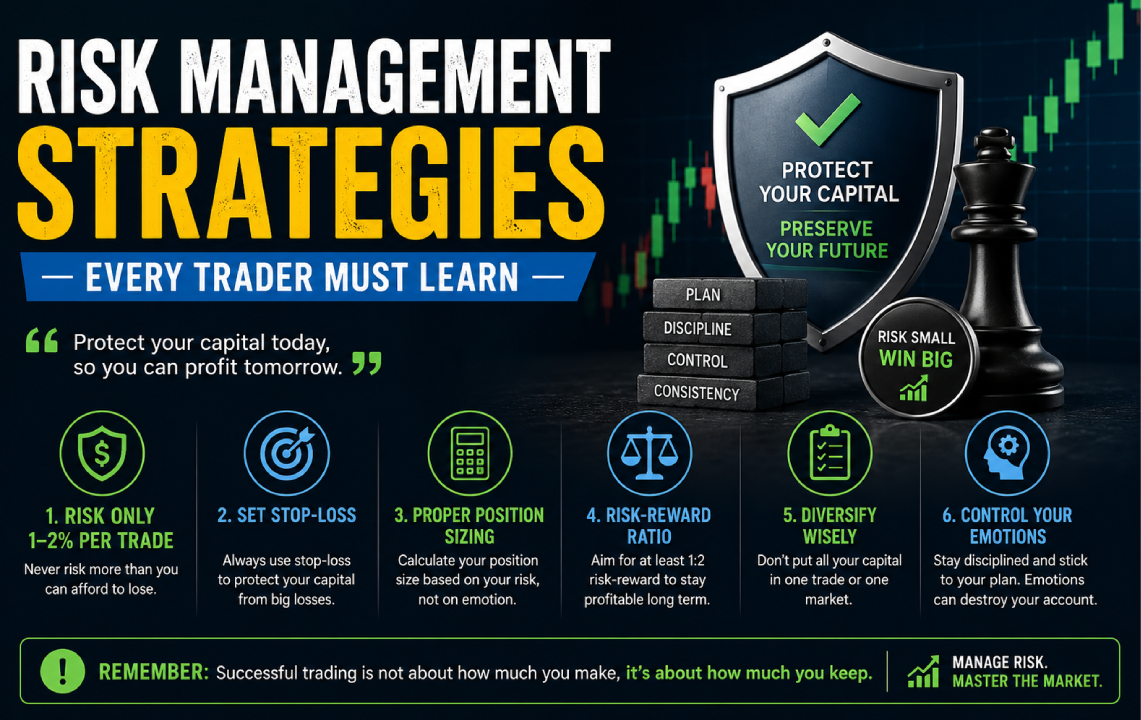
Stop-Loss, Capital Protection & Position Sizing Explained
Trading success is not determined by how often you win—it is determined by how well you manage risk. Many beginner traders focus only on finding profitable entry points, while experienced traders understand that preserving capital is the foundation of long-term success.
Even the best trading strategies experience losing trades. Proper risk management ensures that a few losses do not wipe out your trading account.
Why Risk Management Matters
No trading strategy has a 100% success rate. Markets are unpredictable due to economic events, news, and changing market sentiment.
Risk management helps traders:
- Protect trading capital
- Reduce emotional decision-making
- Survive losing streaks
- Maintain consistent growth
- Build long-term profitability
Professional traders focus on protecting capital first and generating profits second.
1. Use a Stop-Loss on Every Trade
A stop-loss is a predefined price level where your trade automatically closes if the market moves against you.
Benefits of Stop-Loss
- Limits losses
- Removes emotional decisions
- Protects your account
- Encourages disciplined trading
Example
Suppose you buy a stock at ₹1,000.
You decide to risk only ₹30 per share.
Your stop-loss will be:
₹970
If the stock falls to ₹970, the trade exits automatically.
Without a stop-loss, the stock could fall much further, causing unnecessary losses.
2. Never Risk Too Much on One Trade
One of the biggest mistakes beginners make is investing a large portion of their capital in a single trade.
Most professional traders follow the 1% or 2% Risk Rule.
Example
Trading Capital:
₹1,00,000
Maximum Risk per Trade:
1%
Maximum Loss Allowed:
₹1,000
Even if five trades lose consecutively, your account remains largely intact.
3. Position Sizing
Position sizing determines how many shares or lots you should buy based on your risk.
Formula
Position Size = Maximum Risk ÷ Risk Per Share
Example
Capital: ₹1,00,000
Maximum Risk: ₹1,000
Entry Price: ₹500
Stop-Loss: ₹490
Risk Per Share:
₹10
Position Size:
₹1,000 ÷ ₹10 = 100 Shares
This ensures that your maximum loss stays within your predefined limit.
4. Protect Your Trading Capital
Your capital is your business inventory.
Once capital is lost significantly, recovering becomes increasingly difficult.
Example
| Loss | Required Gain to Recover |
|---|---|
| 10% | 11.1% |
| 20% | 25% |
| 30% | 42.9% |
| 40% | 66.7% |
| 50% | 100% |
The larger the loss, the harder it becomes to recover.
5. Maintain a Healthy Risk-to-Reward Ratio
Before entering any trade, compare the possible loss with the expected profit.
Good Example
Risk:
₹100
Target:
₹300
Risk-Reward Ratio:
1 : 3
Even if only half of your trades are successful, you can still remain profitable over time.
6. Avoid Overtrading
Taking too many trades often leads to poor decision-making and unnecessary losses.
Signs of Overtrading
- Trading out of boredom
- Revenge trading after losses
- Ignoring trading rules
- Increasing position size emotionally
Quality trades are always better than quantity.
7. Diversify Your Trades
Avoid investing your entire capital in one stock or one sector.
Diversification reduces the impact of a single bad trade.
Instead of buying only banking stocks, consider spreading investments across sectors such as:
- Banking
- IT
- FMCG
- Pharmaceuticals
- Energy
Balanced exposure helps reduce overall portfolio risk.
8. Control Emotions
Fear and greed are the biggest enemies of traders.
Fear Leads To
- Exiting profitable trades too early
- Missing good opportunities
Greed Leads To
- Holding losing trades
- Ignoring stop-losses
- Overleveraging
Successful traders follow their trading plan rather than emotions.
9. Keep a Trading Journal
Record every trade you take.
Include:
- Entry price
- Exit price
- Stop-loss
- Target
- Reason for entry
- Profit/Loss
- Lessons learned
Reviewing your journal helps identify strengths and weaknesses in your strategy.
10. Always Have a Trading Plan
Never enter a trade without answering these questions:
- Why am I entering this trade?
- Where is my stop-loss?
- What is my target?
- How much money am I risking?
- Is the risk-to-reward ratio acceptable?
A written plan removes guesswork and improves consistency.
Common Risk Management Mistakes
- Trading without a stop-loss
- Risking too much on one trade
- Averaging down on losing positions
- Using excessive leverage
- Ignoring position sizing
- Trading emotionally
- Chasing losses
Avoiding these mistakes can significantly improve long-term performance.
Final Thoughts
Risk management is the backbone of successful trading. While no trader can eliminate losses completely, disciplined use of stop-losses, proper position sizing, sensible capital allocation, and emotional control can help preserve your trading account and improve consistency.
Remember: The primary goal is not to win every trade—it is to protect your capital so you can continue trading tomorrow. Over time, disciplined risk management often makes the difference between traders who survive and those who succeed.