

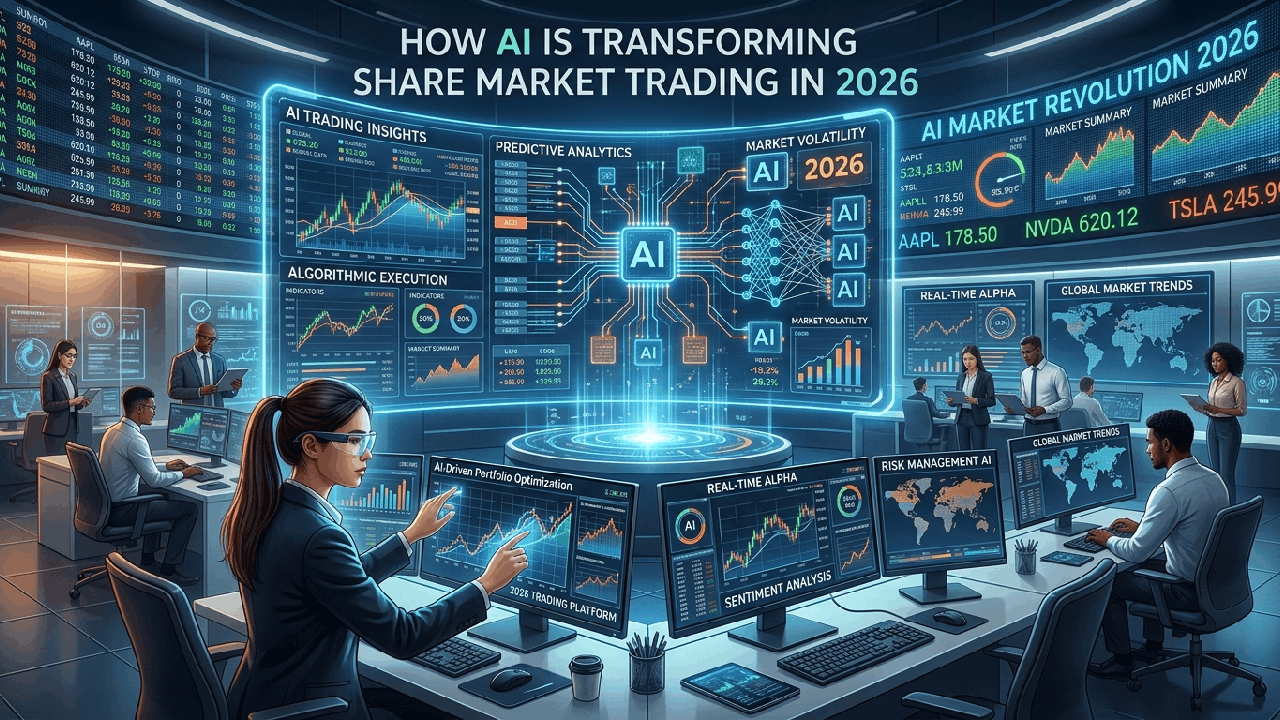
The share market is entering a new era. In 2026, Artificial Intelligence (AI) is no longer just a futuristic concept—it is becoming an important technology across market research, trading analysis, portfolio management, and risk assessment.
From analyzing thousands of market signals in seconds to identifying patterns that may be difficult for humans to spot, AI is changing how traders and investors approach the stock market.
But what exactly is changing, and what does the future of AI-powered trading look like?
The Rise of AI in Share Market Trading
Traditional trading often involves analyzing financial statements, price charts, market news, economic indicators, and company performance. This process can be time-consuming, particularly when traders are monitoring multiple stocks.
AI can process large volumes of structured and unstructured data much faster. Machine learning models can analyze historical price movements, trading volumes, market sentiment, and other indicators to identify potential patterns and generate analytical insights.
This does not mean AI can predict the market with certainty. Financial markets remain influenced by unexpected events, investor behavior, economic changes, and global developments.
Instead, AI is becoming a powerful decision-support tool for traders and investors.
1. Faster Market Data Analysis
One of the biggest advantages of AI is its ability to process huge amounts of information quickly.
AI-powered systems can analyze:
- Stock price movements
- Trading volume
- Technical indicators
- Company financial data
- Economic indicators
- Market news
- Historical market data
- Social media and public sentiment
Instead of manually reviewing hundreds of data points, traders can use AI-based tools to organize information and identify areas that deserve closer attention.
2. AI-Powered Technical Analysis
Technical analysis traditionally relies on indicators such as:
- Moving Averages
- RSI
- MACD
- Bollinger Bands
- Support and Resistance
- Volume Analysis
AI can combine multiple indicators with historical market data to identify relationships and patterns.
For example, an AI model may evaluate price trends, volume changes, volatility, and momentum together rather than relying on a single technical indicator.
The result can be a more data-driven approach to market analysis.
3. Algorithmic and Automated Trading
Algorithmic trading is another area where AI is having a significant impact.
AI-based trading systems can monitor market conditions and execute predefined strategies automatically. Depending on the system, algorithms may evaluate price, volume, volatility, liquidity, and other market variables before generating or executing orders.
Automation can help reduce the influence of emotions such as fear, greed, and panic.
However, automated trading does not eliminate risk. A poorly designed strategy, incorrect assumptions, technical failures, or unusual market conditions can still result in significant losses.
4. Sentiment Analysis: Understanding Market Psychology
Markets are influenced not only by numbers but also by investor sentiment.
AI can analyze large amounts of publicly available text, including:
- Financial news
- Company announcements
- Analyst commentary
- Public market discussions
- Social media posts
Natural Language Processing (NLP) allows AI systems to classify text and estimate whether market commentary is generally positive, negative, or neutral.
For example, a sudden increase in negative sentiment surrounding a company could become another data point for a trader researching that stock.
Sentiment analysis should be treated as one input among many, rather than a standalone trading signal.
5. Personalized Investment Insights
AI is also making financial analysis more personalized.
Instead of providing the same information to every investor, AI-powered platforms can potentially organize insights according to factors such as:
- Investment objectives
- Risk tolerance
- Time horizon
- Portfolio composition
- Asset allocation
- Historical performance
This can make financial information easier to understand and help investors monitor whether their portfolio remains aligned with their objectives.
However, personalized AI suggestions should not automatically be treated as regulated financial advice. Investors should understand the methodology behind any recommendation and consider professional advice where appropriate.
6. AI and Risk Management
Perhaps one of the most valuable applications of AI is risk management.
AI systems can monitor portfolios and identify changes in:
- Volatility
- Correlation between assets
- Concentration risk
- Drawdown
- Liquidity
- Market exposure
Advanced models can also run different scenarios to understand how a portfolio might behave under changing market conditions.
This can help investors think beyond the question:
“How much can I make?”
and focus equally on:
“How much could I lose?”
7. Fraud and Market Surveillance
AI is not only helping traders—it is also helping financial institutions monitor markets.
Machine learning systems can analyze trading activity and identify unusual patterns that may require further investigation.
Potential applications include detecting:
- Suspicious trading patterns
- Unusual transaction activity
- Account anomalies
- Market manipulation indicators
- Other abnormal behavior
As financial markets become increasingly digital, AI-based surveillance is expected to become an increasingly important component of market infrastructure.
8. AI Democratizing Market Research
Historically, sophisticated quantitative research and high-speed data analysis were largely associated with institutional investors.
AI is helping make advanced analytical capabilities more accessible.
Retail investors can increasingly use AI-powered tools to:
- Summarize financial documents
- Compare companies
- Analyze historical data
- Understand technical indicators
- Track portfolios
- Research market trends
- Generate investment research questions
This can reduce the gap between complex financial information and everyday investors.
However, accessibility does not guarantee accuracy. Investors still need to verify information and understand the limitations of AI-generated analysis.
The Human Trader vs. AI
Will AI replace human traders?
Probably not in the simple sense of “humans versus machines.”
The future is more likely to involve human-AI collaboration.
AI is particularly strong at:
- Processing large datasets
- Detecting statistical patterns
- Performing repetitive analysis
- Monitoring markets continuously
- Executing rule-based strategies
Humans remain important for:
- Strategic thinking
- Understanding business context
- Interpreting unexpected events
- Setting investment objectives
- Evaluating assumptions
- Making final decisions
The strongest approach may therefore be to use AI as an analytical assistant rather than blindly following its outputs.
Challenges of AI-Based Trading
Despite its advantages, AI trading comes with significant challenges.
1. No Guaranteed Predictions
AI models learn from historical and current data, but the future can behave differently from the past.
A model that performed well historically can fail when market conditions change.
2. Data Quality
AI is only as reliable as the data it receives.
Incomplete, inaccurate, delayed, or biased data can produce misleading results.
3. Overfitting
A trading model can sometimes become too closely optimized for historical data.
Such a model may appear highly successful during backtesting but perform poorly in real-world markets.
4. Model Risk
AI systems can make incorrect assumptions or generate outputs that appear convincing but are statistically weak.
Understanding the model’s limitations is therefore essential.
5. Cybersecurity
As trading systems become more automated and connected, cybersecurity becomes increasingly important.
Protecting trading infrastructure, APIs, accounts, and financial data is critical.
What Will the Future of AI Trading Look Like?
The next phase of AI-powered trading is likely to focus on increasingly sophisticated systems capable of combining multiple types of information.
Future trading platforms may integrate:
Market Data + News + Fundamentals + Technical Analysis + Sentiment + Risk Models + Portfolio Analytics
into a single analytical environment.
AI agents may also become more capable of monitoring markets, preparing research reports, identifying potential opportunities, and alerting investors when predefined conditions occur.
However, the future of trading will not simply be about having the most advanced AI.
It will be about using technology responsibly, understanding risk, and making informed decisions.
Final Thoughts
AI is fundamentally changing the way share market participants collect information, analyze markets, manage portfolios, and execute strategies.
In 2026, the important question is no longer whether AI will influence trading—it already does.
The bigger question is how effectively traders and investors can combine AI-driven analysis with human judgment, financial knowledge, and disciplined risk management.