

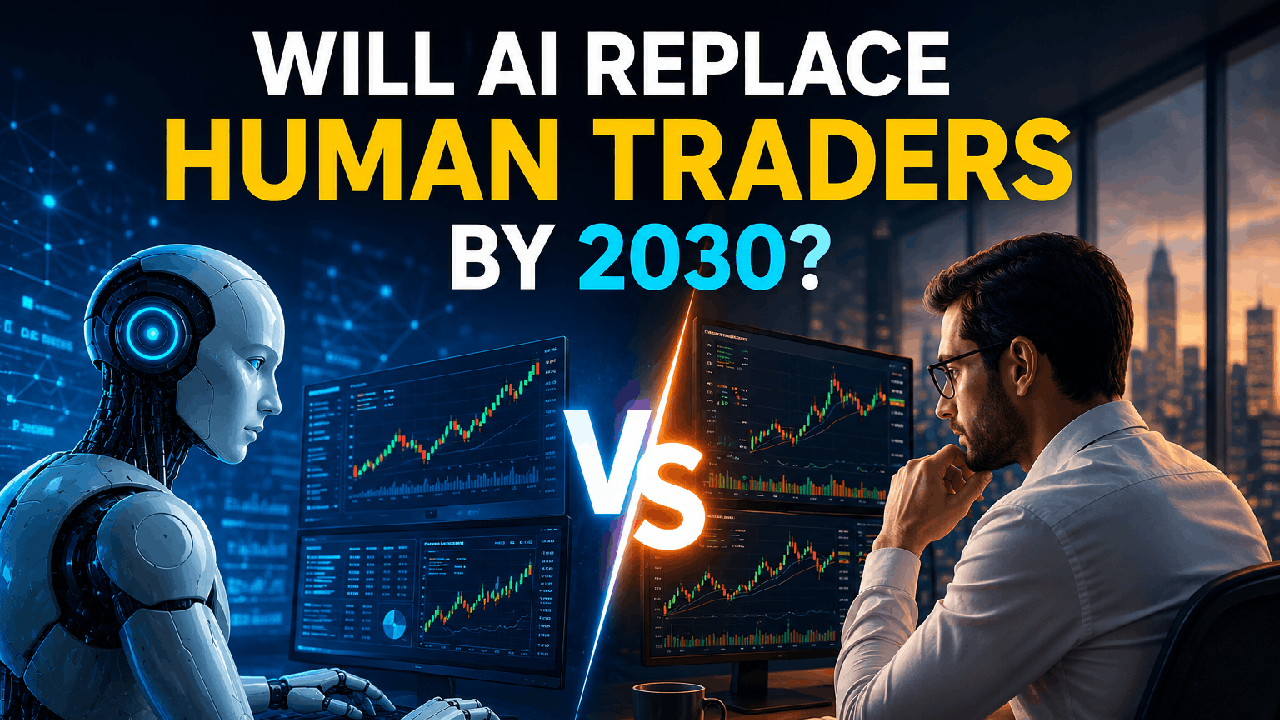
Artificial intelligence is transforming almost every part of the financial industry, and trading is one of the areas experiencing the biggest changes. AI-powered systems can process huge amounts of market data, identify patterns, monitor news, and execute trades within milliseconds. As these technologies continue to improve, an important question is becoming more common: Will AI replace human traders by 2030?
The short answer is unlikely to be a complete replacement. Instead, AI is more likely to change the role of human traders. While machines may take over many repetitive and data-intensive tasks, human judgment, creativity, risk awareness, and strategic thinking can remain important in financial markets.
How AI Is Changing Trading
AI is already being used in several areas of modern trading. Algorithms can analyze historical price data, identify market patterns, calculate indicators, and execute predefined strategies automatically. Unlike humans, computer systems can monitor markets continuously without becoming tired or distracted.
Machine learning models can also analyze large datasets that would be difficult for an individual trader to process manually. This can include price movements, trading volumes, economic indicators, company information, and other market-related data.
As computing power and AI capabilities improve, these systems are likely to become even more sophisticated by 2030.
Why AI Has an Advantage
One of the biggest advantages of AI is speed. Financial markets can move quickly, and automated systems can analyze information and execute orders much faster than a human trader.
AI can also process enormous quantities of data. A human may focus on a limited number of charts or companies, while an automated system can monitor thousands of assets and search for specific patterns simultaneously.
Another advantage is consistency. Human traders can experience fear, greed, hesitation, and overconfidence. An automated system following a predefined strategy does not experience these emotions in the same way.
These advantages make AI particularly useful for systematic and algorithmic trading.
Why Human Traders Still Matter
Despite the rapid development of AI, financial markets are not simply mathematical systems. They are influenced by human behavior, unexpected events, economic decisions, political developments, and changes in investor sentiment.
Human traders can sometimes adapt to situations that were not represented in the data used to develop an AI model. They can question assumptions, interpret unusual circumstances, and change their strategy when market conditions shift.
For example, an unexpected global event could create market conditions that are very different from historical patterns. In such situations, human oversight can become particularly valuable.
AI Can Make Mistakes Too
AI is powerful, but it is not perfect. An AI model can produce incorrect predictions, misunderstand data, or perform poorly when market conditions change.
A strategy that worked well during one market environment may fail during another. This is one reason traders need to understand concepts such as backtesting, overfitting, model risk, and risk management.
There is also a danger of trusting AI-generated recommendations without understanding how they were produced. Traders who blindly follow automated signals may expose themselves to significant losses.
Will AI Replace Day Traders?
Day trading could experience significant automation by 2030. Many repetitive tasks, such as scanning markets, identifying technical conditions, and executing predefined orders, can already be automated.
This does not necessarily mean that every day trader will disappear. Instead, individual traders may increasingly use AI tools to improve their research and decision-making.
A trader who knows how to work with AI could potentially have an advantage over someone who relies entirely on manual analysis. The future may therefore favor traders who understand both financial markets and technology.
The Rise of Human-AI Collaboration
The most realistic future may not be AI versus humans, but AI plus humans.
AI can handle large-scale data analysis, pattern recognition, monitoring, and repetitive processes. Humans can focus on strategy development, interpretation, risk decisions, creativity, and oversight.
This combination could create a new type of trader who uses AI as a powerful assistant rather than treating it as a complete replacement.
For example, a human trader might use AI to scan hundreds of companies for specific financial or technical conditions. The trader could then review the results, conduct additional research, evaluate the risks, and make the final decision.
What Traders Should Learn Before 2030
As AI becomes more important in financial markets, traders may need to develop skills beyond traditional chart analysis.
Understanding data, automation, algorithmic trading, AI tools, statistics, and risk management could become increasingly valuable. Traders do not necessarily need to become professional programmers, but having a basic understanding of how AI and automated systems work can help them use these technologies more effectively.
Soft skills will also remain important. Critical thinking, discipline, adaptability, and decision-making can help traders manage situations where technology does not provide a perfect answer.
Could AI Create More Competition?
AI could also increase competition in financial markets. If more traders and institutions gain access to powerful analytical tools, identifying simple market opportunities may become more difficult.
Strategies that once provided an advantage can become less effective when many participants use similar technologies. This could encourage traders to focus more on unique data, better risk management, specialized strategies, and continuous innovation.
In other words, AI may not make trading easier. It could make the trading environment more competitive.
What Could Trading Look Like in 2030?
By 2030, trading may become significantly more technology-driven. AI systems could monitor markets continuously, identify potential opportunities, optimize portfolios, detect unusual activity, and assist with risk management.
Human traders may increasingly move away from manually watching charts all day. Instead, they could focus on designing strategies, supervising AI systems, interpreting complex situations, and making higher-level decisions.
The exact future is impossible to predict, but one thing is clear: technology will likely play a much larger role in financial markets.
Final Thoughts
Will AI replace human traders by 2030? A complete replacement is unlikely. AI is extremely powerful at processing data, recognizing patterns, and executing predefined tasks, but financial markets involve uncertainty and human behavior that cannot always be reduced to a simple algorithm.
The bigger opportunity may be for traders who learn to work alongside AI. Instead of competing directly against technology, traders can use it to improve research, reduce repetitive work, test ideas, and make more informed decisions.