

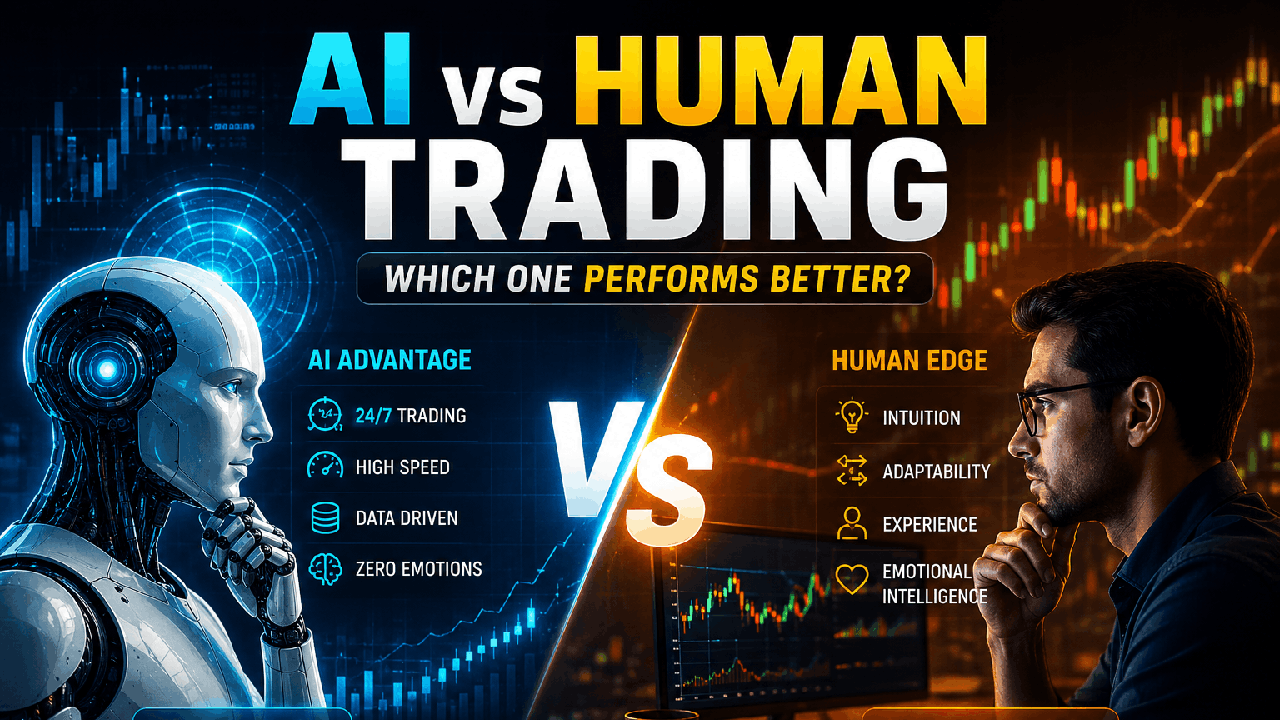
AI vs Human Trading: Which One Performs Better?
The trading world is changing rapidly with the rise of Artificial Intelligence (AI). Today, traders can use AI-powered tools to analyze market data, identify patterns, and even execute trades automatically.
But this raises an important question: Can AI really outperform human traders?
The answer isn’t as simple as choosing one over the other. AI has advantages such as speed, data processing, and consistency, while humans bring experience, intuition, creativity, and judgment. Let’s compare both approaches.
1. What Is AI Trading?
AI trading uses algorithms, machine learning, and data analysis to make trading decisions. These systems can process large amounts of market information much faster than a human.
AI trading systems can:
- Analyze large volumes of market data
- Identify patterns and trends
- Execute trades within milliseconds
- Follow predefined strategies consistently
- Operate 24/7 without fatigue
- Reduce emotional decision-making
This makes AI particularly useful for high-frequency trading, algorithmic strategies, and data-driven analysis.
2. What Is Human Trading?
Human trading relies on a trader’s knowledge, experience, market understanding, and decision-making skills.
Human traders can analyze:
- Price charts and technical indicators
- Economic news
- Market sentiment
- Company fundamentals
- Global events
- Investor psychology
One major advantage humans have is adaptability. When unexpected events occur, experienced traders can consider the broader situation and change their strategy based on judgment.
3. AI vs Human Trading: Head-to-Head Comparison
| Factor | AI Trading | Human Trading |
|---|---|---|
| Speed | Extremely fast | Relatively slower |
| Data Processing | Can analyze huge datasets | Limited by human capacity |
| Emotions | Emotion-free | Emotions can influence decisions |
| Consistency | Highly consistent | Performance can vary |
| Adaptability | Depends on programming and models | Can adapt using judgment |
| Risk Management | Rule-based and systematic | Depends on trader discipline |
| Creativity | Limited by its design and training | Strong human creativity |
| Availability | Can operate 24/7 | Requires rest |
| Decision Making | Data and algorithms | Experience and judgment |
4. Where Does AI Have an Advantage?
AI’s biggest advantage is speed and scalability.
A computer can monitor thousands of data points simultaneously and execute predefined strategies without hesitation. It doesn’t become nervous after a losing trade or greedy after a winning trade.
AI can also help traders backtest strategies using historical data and identify patterns that may be difficult for humans to recognize.
However, AI is not perfect. A model trained on historical market conditions may struggle when the market behaves in an unexpected way.
5. Where Do Humans Have an Advantage?
Humans are particularly valuable when markets become uncertain.
For example, during unexpected geopolitical events, economic announcements, or sudden changes in investor sentiment, an experienced trader can consider information that may not be fully captured by an algorithm.
Humans can also question their own assumptions and change their approach when circumstances change.
The biggest challenge for human traders, however, is emotion. Fear, greed, overconfidence, and impatience can lead to poor trading decisions.
6. Can AI Completely Replace Human Traders?
Probably not—at least not in every type of trading.
AI is excellent at processing information and executing predefined strategies, but financial markets are complex and constantly changing. A strategy that works today may perform poorly under different market conditions.
Human oversight can therefore remain important for:
- Strategy development
- Risk evaluation
- Monitoring AI systems
- Understanding unusual market conditions
- Making high-level decisions
Instead of replacing humans completely, AI is increasingly becoming a powerful trading assistant.
7. The Best Approach: AI + Human
The real opportunity may not be AI vs Human, but AI + Human.
A trader can use AI to handle repetitive and data-intensive tasks while using human judgment for strategy, risk management, and unusual market situations.
For example:
AI → Data analysis → Pattern detection → Alerts → Trade execution
Human → Strategy → Risk assessment → Market context → Final decision
This combination can allow traders to take advantage of the strengths of both.
8. Final Verdict
So, which performs better—AI or humans?
There is no universal winner.
AI is faster, more consistent, and capable of processing enormous amounts of data. Humans are more adaptable, creative, and capable of understanding context and making judgment-based decisions.
The strongest approach may be to use AI for what machines do best and humans for what humans do best.
The Future of Trading
The future of trading is likely to become increasingly technology-driven. Traders who learn how to use AI tools effectively while developing strong financial knowledge and risk-management skills may have an advantage.
The goal isn’t to choose between AI and human intelligence. It’s to combine them intelligently.
Pro Tip: Use AI as a tool to support your trading analysis—not as a guarantee of profits. Always understand the strategy, manage your risk, and make informed decisions.