

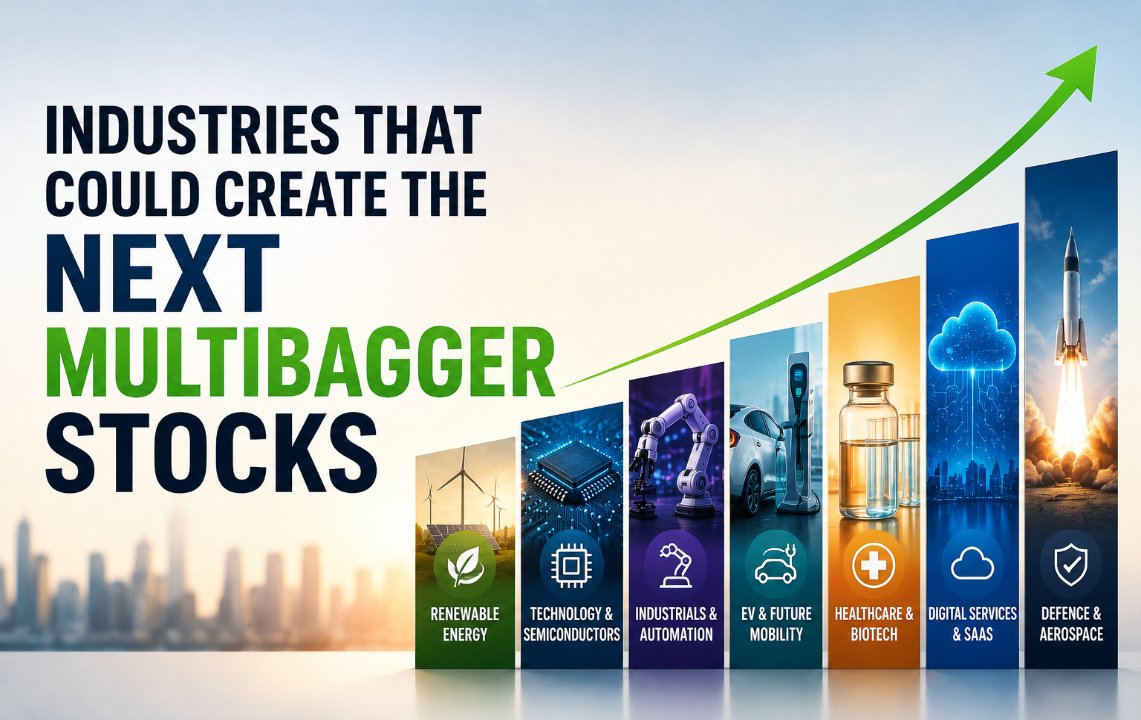
Finding the next multibagger stock is one of the biggest ambitions of long-term investors.
A multibagger is generally a stock that multiplies an investor’s original investment several times over—for example, a 5x, 10x or even 20x return. But identifying such companies is rarely about finding the most popular stock today. The biggest winners often emerge from industries undergoing long-term structural change.
For Indian investors, the 2026–2030 period could be particularly interesting. India’s expanding economy, rising capital expenditure, manufacturing ambitions, digital transformation, energy transition and increasing technology adoption are creating opportunities across several industries.
Recent industry projections point toward strong growth in areas such as semiconductors, data centers, renewable energy, capital goods and electronics manufacturing.
But an important warning comes first:
A promising industry does not automatically produce multibagger stocks.
The company still needs strong management, sustainable competitive advantages, healthy cash flows, manageable debt and a valuation that leaves room for future returns.
With that in mind, here are some industries worth watching.
1. Semiconductor and Electronics Manufacturing
Semiconductors could become one of India’s most important emerging industries over the next decade.
India has historically been strong in semiconductor design but has depended heavily on imports for manufacturing. That is beginning to change as government initiatives and private investment aim to develop a domestic semiconductor ecosystem.
India’s semiconductor market has been projected to approach $100–110 billion by 2030, driven by AI, electric vehicles, data centers and defence applications.
Areas to watch:
- Semiconductor manufacturing
- Chip design
- Semiconductor equipment
- Electronics manufacturing services
- Components
- Advanced packaging
- Power semiconductors
The opportunity could extend beyond chip manufacturers to companies supplying equipment, materials, testing, electronics and industrial infrastructure.
Multibagger potential: High
Risk: High, because manufacturing is capital-intensive and technologically complex.
2. AI Infrastructure and Data Centers
Artificial intelligence is not just a software story.
Every AI model requires computing power, servers, networking equipment, electricity, cooling and data-center infrastructure.
India’s Economic Survey projects data-center capacity to rise from around 1.4 GW in Q2 2025 to about 8 GW by 2030.
Deloitte has separately estimated that India’s installed data-center capacity could reach approximately 10 GW by 2030.
This creates a large ecosystem of potential beneficiaries.
Potential opportunities:
- Data-center operators
- Power equipment
- Cooling systems
- Electrical equipment
- Cloud infrastructure
- Networking
- Backup power
- Fibre connectivity
- Data-center construction
The bigger opportunity may actually be in the “picks and shovels” of AI—the companies providing the infrastructure that allows AI to operate.
KPMG estimates an approximately $90 billion opportunity across India’s end-to-end data-center value chain by FY35.
3. Defence and Aerospace
India’s defence industry is undergoing a major transformation.
The country is increasingly focused on domestic manufacturing, reducing import dependence and developing defence-export capabilities.
This could create long-term opportunities across:
- Defence electronics
- Drones
- Radar systems
- Missiles
- Naval systems
- Aerospace components
- Unmanned systems
- Communications
- Electronic warfare
The defence theme is particularly interesting because demand can be supported by both government procurement and technological modernization.
However, investors should carefully examine order-book quality, execution, working capital and the percentage of revenue dependent on government contracts.
Multibagger potential: High
Risk: Government-policy, execution and valuation risks.
4. Renewable Energy and Energy Storage
India’s transition toward renewable energy could create one of the largest industrial opportunities of the coming decade.
India’s renewable-energy buildout is expected to remain substantial, while battery storage is also becoming increasingly important. CRISIL expects renewable capacity additions of roughly 50–55 GW annually over the current and next fiscal years and highlights battery storage as an important part of the infrastructure expansion.
Industries to watch:
- Solar manufacturing
- Solar EPC
- Wind energy
- Battery storage
- Power transmission
- Power electronics
- Green hydrogen
- Energy-management systems
The opportunity is especially interesting because renewable energy intersects with another major trend:
AI + Data Centers + Electrification = Rising Power Demand
As data centers consume more electricity, reliable and increasingly clean power could become even more valuable.
5. Power Transmission and Electrical Equipment
One of the less glamorous—but potentially very important—investment themes is the electricity infrastructure required to support India’s growth.
More factories, EVs, renewable projects and data centers mean more demand for electricity transmission and distribution.
Companies involved in:
- Transformers
- Switchgear
- Cables
- Transmission equipment
- Grid modernization
- Power electronics
- Industrial electrical systems
could benefit from this investment cycle.
CRISIL expects capital-goods companies to maintain double-digit revenue growth, supported by government spending, industrial capacity expansion, power investments, data centers and EV infrastructure.
6. Capital Goods and Industrial Automation
India may be entering a new industrial capex cycle.
As companies expand manufacturing capacity, they need machinery, automation, engineering services and industrial equipment.
CRISIL estimates industrial capex could rise substantially toward FY2030, with emerging areas such as EVs, semiconductors and electronics becoming increasingly important contributors.
Potential beneficiaries:
- Industrial machinery
- Automation
- Robotics
- Engineering
- Electrical equipment
- Factory automation
- Industrial software
- Material handling
The biggest winners could be companies that combine technology + manufacturing + recurring service revenue.
7. Electric Vehicles and Auto Components
The EV opportunity is larger than simply investing in automobile manufacturers.
Electric mobility requires an entirely different supply chain.
Potential growth areas:
- EV motors
- Batteries
- Battery-management systems
- Power electronics
- Charging infrastructure
- Lightweight materials
- Auto electronics
- Battery recycling
India’s EV ecosystem is also closely connected to semiconductor and electronics manufacturing.
This means investors can potentially benefit from the broader electrification trend without necessarily betting on a single EV brand.
8. Pharmaceuticals and Healthcare
Healthcare is one of the industries that can potentially benefit from long-term demographic and economic trends.
Rising healthcare spending, increasing insurance penetration, exports and pharmaceutical innovation could support the sector.
Potential opportunities include:
- Specialty pharmaceuticals
- Contract development and manufacturing
- Medical devices
- Diagnostics
- Biotechnology
- Hospital chains
- Healthcare technology
Pharmaceuticals have also been among India’s stronger-performing sectors in 2026 so far, although past performance should never be treated as a guarantee of future returns.
The strongest opportunities may come from companies with differentiated products, strong R&D capabilities and global market access.
9. Financial Technology and Wealth Management
India’s financial system is becoming increasingly digital.
UPI, mobile banking, online investing, insurance technology and digital lending have transformed how consumers interact with financial services.
The next phase could involve:
- Wealth management
- Investment platforms
- Insurance technology
- Digital banking
- Financial analytics
- Asset management
- Credit technology
However, fintech investors need to distinguish between rapid user growth and sustainable profitability.
A company with millions of users is not necessarily a great investment if customer acquisition costs remain high.
10. Logistics and Industrial Supply Chains
Manufacturing growth requires efficient logistics.
As India becomes more integrated into global supply chains, demand could increase for:
- Warehousing
- Freight transportation
- Ports
- Rail logistics
- Cold chains
- Industrial parks
- Supply-chain technology
The growth of e-commerce and organized manufacturing could further strengthen this industry.
Companies that combine physical infrastructure with technology-driven logistics may have an advantage.
11. Specialty Chemicals and Advanced Materials
Specialty chemicals can be another interesting long-term theme because they sit behind numerous industries.
Demand comes from:
- Pharmaceuticals
- Electronics
- Agriculture
- Automobiles
- Batteries
- Renewable energy
- Industrial manufacturing
India’s opportunity lies partly in becoming an alternative manufacturing base within global supply chains.
But investors should pay close attention to commodity cycles, export exposure, environmental regulations and customer concentration.
12. Cybersecurity and Digital Infrastructure
As India’s economy becomes more digital, cybersecurity becomes increasingly important.
Companies are moving more operations to cloud platforms while AI is creating new forms of cyber risk.
Potential growth areas include:
- Cloud security
- Identity management
- Data protection
- Fraud prevention
- AI security
- Network security
- Cybersecurity software
This industry could benefit from a simple reality:
The more valuable the data becomes, the more companies are willing to spend protecting it.
What Makes an Industry Capable of Producing Multibaggers?
Not every growing industry creates multibagger stocks.
Investors should look for industries with several characteristics.
1. Large and Expanding Market
The company’s addressable market should have room to grow significantly.
2. High Revenue Growth
A business cannot become a major long-term wealth creator without substantial earnings growth.
3. Strong Competitive Advantage
Look for intellectual property, technology, distribution, brand strength, cost advantages or customer relationships.
4. High Return on Capital
Companies that consistently generate strong returns on invested capital can potentially compound wealth more efficiently.
5. Low or Manageable Debt
Rapid expansion financed by excessive borrowing can destroy shareholder value during downturns.
6. Strong Management
Capital allocation and corporate governance matter enormously over a 5–10 year period.
7. Reasonable Valuation
Even an excellent company can produce poor returns if investors pay an excessively high price.
The “Multibagger Formula”
A useful way to think about potential multibaggers is:
Large Market + Strong Growth + Competitive Advantage + High Profitability + Good Management + Reasonable Valuation = Potential Multibagger
But there is no guaranteed formula.
A company can have a fantastic industry opportunity and still fail because of:
- Poor execution
- Excessive debt
- Weak management
- Competition
- Regulatory changes
- Overvaluation
- Technology disruption
Industries to Watch From 2026 to 2030
| Industry | Long-Term Opportunity | Key Risk |
|---|---|---|
| Semiconductors | Very High | Execution & capital intensity |
| AI & Data Centers | Very High | Valuations & power constraints |
| Defence | High | Policy & order execution |
| Renewable Energy | Very High | Competition & capital costs |
| Power Infrastructure | High | Regulation & project execution |
| Capital Goods | High | Economic cycles |
| EV & Components | High | Technology & competition |
| Healthcare | High | Regulation & R&D risk |
| Fintech | High | Regulation & profitability |
| Logistics | Medium–High | Competition & margins |
| Specialty Chemicals | High | Global cycles |
| Cybersecurity | High | Rapid technology change |
The Biggest Opportunity May Be at the Intersection of Industries
Some of the most interesting future businesses may not fit into just one sector.
Consider this chain:
AI → Data Centers → Electricity → Renewable Energy → Power Transmission → Semiconductors
Or:
EVs → Batteries → Semiconductors → Power Electronics → Charging Infrastructure
Or:
Defence Modernization → Electronics → Semiconductors → Drones → AI
These intersections can create powerful investment ecosystems.
For example, India’s AI expansion is simultaneously increasing demand for data centers, chips and electricity infrastructure.
How Investors Should Search for the Next Multibagger
Instead of asking:
“Which stock will become the next 10x?”
Ask:
“Which industries could grow 5–10 times over the next decade?”
Then identify companies within those industries that have:
- Growing revenues
- Growing profits
- Strong cash flows
- High return on capital
- Low or manageable debt
- Strong competitive advantages
- Experienced management
- Large addressable markets
- Sensible valuations
This approach focuses on business fundamentals rather than speculation.
Final Thoughts
The next generation of Indian multibagger stocks could emerge from industries that are still in the early stages of their growth cycles.
Semiconductors, AI infrastructure, data centers, defence, renewable energy, power equipment, industrial automation, EVs, healthcare and digital infrastructure are among the areas worth watching through 2030.
Several of these themes are supported by major structural investment trends. India’s industrial capex is expected to increase, while data-center capacity, semiconductor manufacturing and renewable-energy infrastructure are all expanding.
But the goal should not be to predict the next multibagger with certainty.
The better strategy is to identify high-quality businesses operating in high-growth industries before their full potential becomes obvious to the market.
And perhaps the most important lesson is: A great industry can create opportunities—but a great company creates shareholder wealth.