

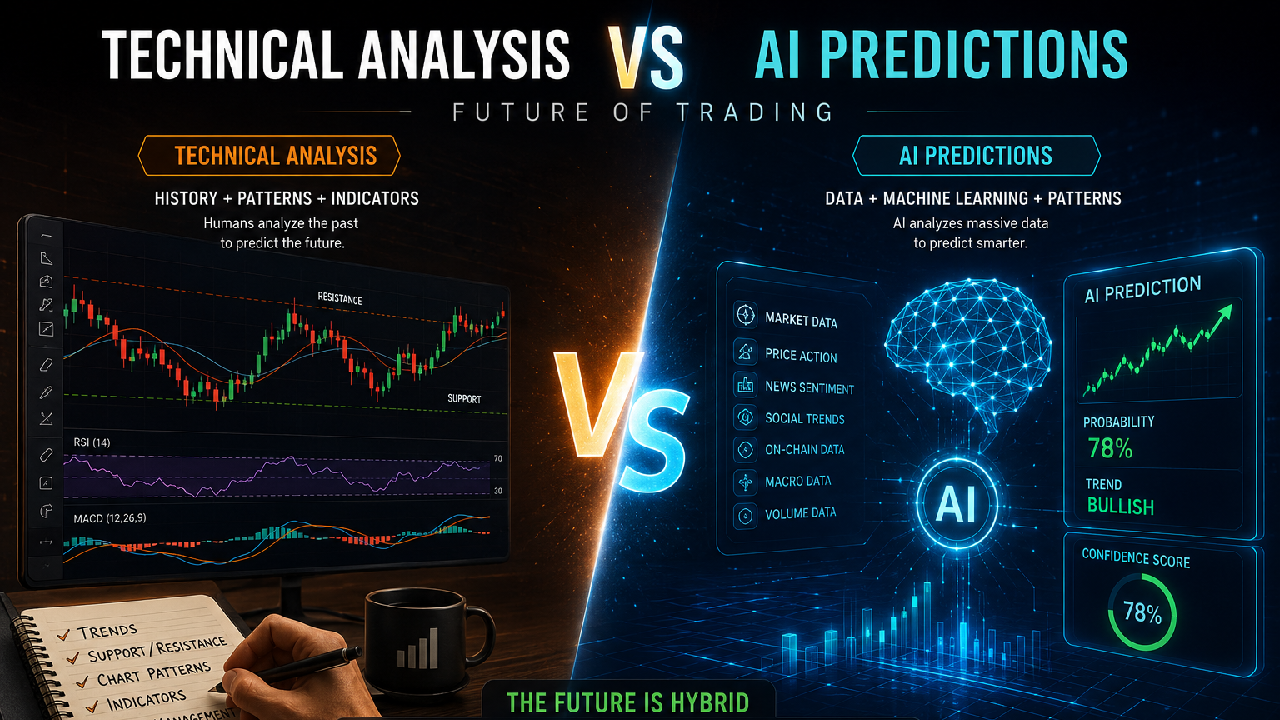
The financial markets have evolved dramatically over the past decade. While traders once relied solely on chart patterns, indicators, and market experience, today’s investors also have access to Artificial Intelligence (AI) that can analyze millions of data points in seconds.
But does this mean AI will replace human traders?
The answer isn’t that simple. Both Technical Analysis and AI-driven predictions have unique strengths and limitations. The future of trading is likely to involve a combination of both rather than one replacing the other.
In this article, we’ll compare traditional technical analysis with AI-powered trading and explore what the future holds.
What is Technical Analysis?
Technical Analysis (TA) is the practice of analyzing historical price movements, chart patterns, and trading volume to predict future market behavior.
Traders use tools such as:
- Candlestick patterns
- Support and resistance levels
- Trend lines
- Moving Averages
- RSI (Relative Strength Index)
- MACD
- Fibonacci Retracement
- Bollinger Bands
Technical analysis assumes that market prices reflect all available information and that history often repeats itself because human behavior remains consistent.
What Are AI Trading Predictions?
AI trading uses Machine Learning (ML) and advanced algorithms to analyze massive datasets and identify patterns that humans might overlook.
AI systems can evaluate:
- Historical price data
- News headlines
- Economic reports
- Social media sentiment
- Trading volume
- Global market trends
- Cryptocurrency blockchain data
- Company financial reports
Unlike traditional indicators, AI continuously learns and adapts as new data becomes available.
Technical Analysis vs AI Predictions
| Feature | Technical Analysis | AI Predictions |
|---|---|---|
| Speed | Human analysis | Instant processing |
| Data Analysis | Limited datasets | Millions of data points |
| Emotional Bias | Yes | No emotions |
| Learning Ability | Depends on trader | Continuously improves with data |
| Flexibility | High | Depends on model quality |
| Cost | Mostly free | Often requires premium tools |
| Best For | Individual traders | Institutions and advanced traders |
Advantages of Technical Analysis
Easy to Learn
Beginners can start with simple indicators like Moving Averages and RSI.
Better Market Understanding
Technical analysis helps traders understand why prices move rather than simply receiving buy or sell signals.
Flexible
It works across:
- Stocks
- Forex
- Cryptocurrency
- Commodities
- Indices
Low Cost
Many charting platforms provide powerful technical indicators for free.
Limitations of Technical Analysis
Despite its popularity, technical analysis has limitations:
- Indicators often lag behind price movement.
- Different traders interpret the same chart differently.
- Unexpected news can invalidate chart patterns.
- Emotional decisions can lead to poor trades.
No indicator guarantees success.
Advantages of AI Trading
Massive Data Processing
AI can analyze years of historical data within seconds.
No Emotional Trading
AI never experiences:
- Fear
- Greed
- FOMO
- Panic
It follows predefined rules consistently.
Pattern Recognition
Machine learning can identify hidden relationships that are difficult for humans to detect.
24/7 Monitoring
AI systems can monitor global markets continuously without fatigue.
Limitations of AI Trading
AI is powerful, but it’s not perfect.
Challenges include:
- High setup costs
- Dependence on quality data
- Risk of overfitting to historical trends
- Difficulty predicting unprecedented events
- Lack of human judgment during unique market conditions
AI is only as effective as the data and models it uses.
Can AI Replace Human Traders?
Not entirely.
Human traders still have advantages in areas such as:
- Understanding market psychology
- Interpreting unexpected news
- Adapting to changing conditions
- Making strategic decisions beyond historical data
AI excels at processing information quickly, while humans provide context and experience.
The Best Approach: Human + AI
Rather than choosing one over the other, many successful traders combine both approaches.
For example:
- Use AI to identify potential trading opportunities.
- Confirm those opportunities using technical analysis.
- Apply risk management before entering a trade.
- Make the final decision based on both data and market context.
This hybrid approach combines the speed of AI with the judgment of experienced traders.
The Future of Trading
Over the next few years, AI is expected to become even more integrated into trading by:
- Detecting market sentiment from news and social media.
- Improving automated trading strategies.
- Enhancing portfolio management.
- Delivering personalized trading insights.
- Assisting traders with real-time risk management.
However, the fundamentals of successful trading—discipline, patience, and sound risk management—will remain essential.
Tips for Beginners
If you’re new to trading:
- Learn technical analysis before relying on AI tools.
- Understand why a trade makes sense instead of blindly following predictions.
- Practice on a demo account before risking real money.
- Always use stop-loss orders and manage your risk.
- Treat AI as a decision-support tool, not a guaranteed source of profits.
Final Thoughts
Technical analysis and AI predictions are not competitors—they are complementary tools. Technical analysis provides insight into price action and market structure, while AI brings speed, large-scale data analysis, and pattern recognition. The most effective traders of the future are likely to combine both approaches instead of relying entirely on one.
As AI technology continues to evolve, traders who understand both traditional market analysis and modern machine learning tools will be better positioned to adapt to changing markets. The future of trading belongs not to humans or machines alone, but to those who can use both wisely.