

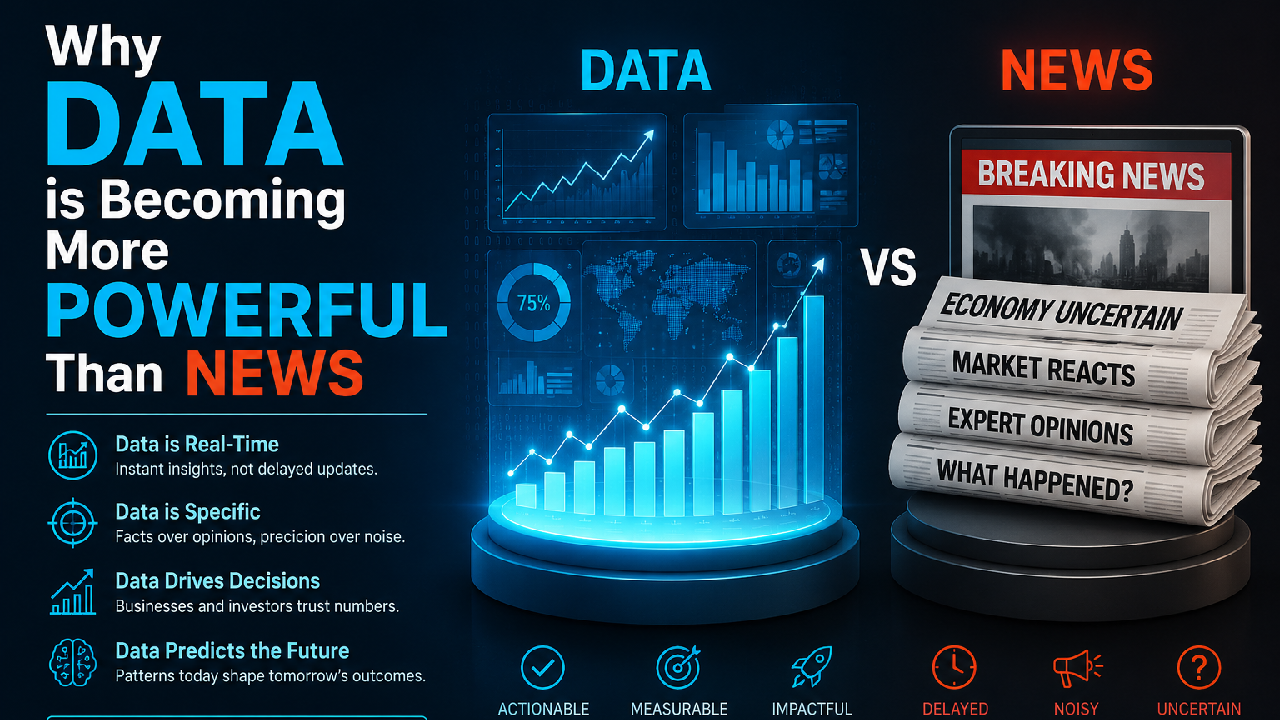
In today’s fast-moving financial markets, information travels faster than ever. Breaking news can spread across the globe in seconds, but by the time most traders read the headlines, professional investors and trading algorithms have often already reacted.
This shift has made data more valuable than traditional news. Instead of waiting for articles or TV reports, modern traders rely on real-time data, analytics, and Artificial Intelligence (AI) to make informed decisions.
In this article, we’ll explore why data is becoming the driving force behind trading and how it is shaping the future of investing.
The Difference Between News and Data
Although news and data are related, they serve different purposes.
News
News provides information about events, such as:
- Company earnings
- Government policies
- Interest rate decisions
- Economic reports
- Political developments
- Global crises
News explains what happened.
Data
Data consists of measurable information that can be analyzed, including:
- Price movements
- Trading volume
- Market sentiment
- Economic indicators
- Blockchain transactions
- Institutional buying and selling
- Order book activity
- Inflation and employment statistics
Data helps explain why markets move and what may happen next.
Why Data Matters More Today
Financial markets generate billions of data points every day.
Modern trading platforms analyze:
- Stock prices
- Cryptocurrency transactions
- Forex market movements
- Commodity prices
- Interest rates
- Economic releases
- Social media sentiment
- Search engine trends
Unlike news, data updates continuously, giving traders a more complete picture of market conditions.
The Problem with News-Based Trading
Many beginners trade immediately after reading a news headline.
For example:
“Company XYZ reports record profits.”
By the time this news reaches the average investor:
- Institutional traders may have already acted.
- AI-powered systems may have processed the information in milliseconds.
- The price may already reflect the announcement.
This is why traders often say:
“Buy the rumor, sell the news.”
Markets frequently react before the public fully understands the story.
How Data Gives Traders an Advantage
Real-Time Insights
Live market data allows traders to react instantly instead of waiting for news summaries.
Pattern Recognition
Historical data helps identify trends and recurring market behaviors.
Better Risk Management
Data helps traders calculate:
- Position size
- Volatility
- Risk-to-reward ratio
- Probability of success
Objective Decisions
Unlike headlines that may trigger emotional reactions, data provides measurable evidence for decision-making.
The Rise of AI and Big Data
Artificial Intelligence has transformed how markets are analyzed.
AI can process:
- Millions of price updates
- Economic reports
- Financial statements
- News articles
- Social media discussions
- Global market activity
Machine learning models identify patterns that would be difficult for humans to detect manually, enabling faster and more informed trading decisions.
Examples of Data-Driven Trading
Modern traders increasingly rely on data such as:
Market Sentiment
AI analyzes millions of social media posts and financial discussions to estimate whether investors are bullish or bearish.
Volume Analysis
A sudden increase in trading volume can indicate growing interest before major price movements.
Economic Indicators
Professional traders closely monitor:
- Inflation (CPI)
- GDP growth
- Unemployment rates
- Central bank interest rates
These metrics often influence markets more than opinions or rumors.
On-Chain Data (Crypto)
Cryptocurrency investors analyze blockchain activity, including:
- Wallet movements
- Exchange inflows and outflows
- Whale transactions
- Network activity
These insights often reveal trends before they appear in mainstream news.
Why Human Traders Still Matter
Despite the power of AI and data, human judgment remains valuable.
Experienced traders can:
- Understand market psychology.
- Recognize unusual market conditions.
- Evaluate geopolitical events.
- Adapt strategies during unexpected crises.
The best results often come from combining data analysis with human experience.
The Future of Trading
Over the next decade, trading is expected to become even more data-driven through:
- AI-powered market analysis
- Predictive analytics
- Real-time risk management
- Personalized trading insights
- Automated portfolio optimization
Rather than replacing traders, these technologies will help them make faster and more informed decisions.
Tips for Beginners
If you’re just starting your trading journey:
- Learn how to read charts and market data.
- Follow reliable economic indicators.
- Avoid making decisions based solely on headlines.
- Understand the story behind the numbers.
- Use data to support—not replace—your trading strategy.
- Always practice proper risk management.
Final Thoughts
The financial markets are evolving from news-driven to data-driven decision-making. While news remains important for understanding events, data provides deeper, faster, and more actionable insights. AI and machine learning have further accelerated this shift by processing vast amounts of information in real time.
Successful traders of the future won’t simply react to headlines—they’ll analyze the data behind them. By combining technical analysis, fundamental understanding, and data-driven insights, traders can make more informed decisions and stay ahead in increasingly competitive markets.