

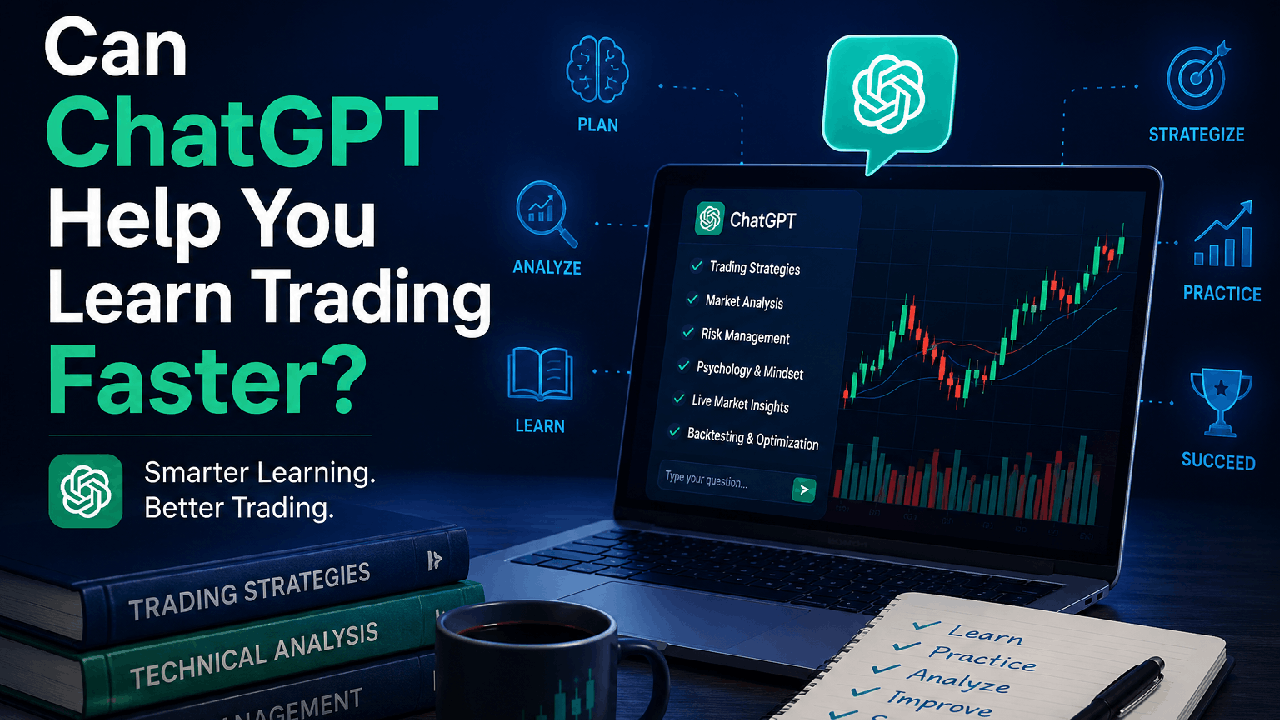
Trading can look complicated when you are just starting. Charts, indicators, market news, technical analysis, risk management, and trading strategies can feel overwhelming. Traditionally, beginners spend months searching for tutorials, watching videos, reading books, and trying to understand different trading concepts. Today, AI tools such as ChatGPT can make the learning process faster by helping traders understand complex topics in a simpler and more interactive way.
ChatGPT as a Trading Learning Assistant
ChatGPT can act like a personal learning assistant for beginners who want to understand trading. You can ask questions about stocks, forex, cryptocurrency, technical analysis, candlestick patterns, support and resistance, trading psychology, and risk management. Instead of searching through multiple websites for a basic explanation, you can ask ChatGPT to explain a concept step by step and at your preferred level.
For example, a beginner can ask, “What is a support level in trading?” ChatGPT can explain the concept in simple language and provide examples. If the explanation is still confusing, you can ask follow-up questions or request an even simpler explanation. This interactive learning process can help reduce the time required to understand fundamental trading concepts.
Learn Technical Analysis More Easily
Technical analysis involves studying price charts and using tools such as moving averages, RSI, MACD, trendlines, and support and resistance levels. Beginners often struggle to understand when and why these indicators are used.
ChatGPT can help explain what different indicators do, how traders commonly interpret them, and what their limitations are. It can also help create study exercises and explain concepts such as bullish and bearish trends, chart patterns, candlestick formations, and market momentum.
However, understanding an indicator is not the same as knowing how to trade profitably with it. Traders still need to practice using charts and evaluate strategies using historical data.
Build a Trading Study Plan
One of the biggest advantages of using ChatGPT for learning is that it can help organize information into a structured learning plan. Instead of randomly jumping between trading videos and articles, beginners can create a step-by-step roadmap.
A learning plan could start with market basics, followed by technical analysis, fundamental analysis, risk management, trading psychology, strategy development, backtesting, and finally paper trading. This structured approach can help learners focus on one skill at a time rather than trying to learn everything simultaneously.
Practice With Trading Scenarios
ChatGPT can also be used to create hypothetical trading scenarios. For example, you could provide a fictional market situation and ask what factors a trader should consider before entering a trade. You can then compare different approaches and learn how traders think about entry points, stop-loss levels, position sizing, and potential risk.
This type of practice can be useful because trading is not only about memorizing definitions. It requires decision-making under uncertainty. Scenario-based learning can help beginners develop a better understanding of the thought process involved in trading.
Risk Management Should Come First
Learning how to make profits is attractive to every new trader, but learning how to manage losses is even more important. ChatGPT can explain important risk-management concepts such as stop-loss orders, position sizing, risk-to-reward ratios, diversification, and maximum loss limits.
For example, a trader can ask ChatGPT to explain why risking too much capital on a single trade can damage a trading account. It can also help demonstrate hypothetical calculations so that beginners understand how position size and risk percentage affect a trade.
Good risk management cannot guarantee profits, but it can help traders control potential losses and avoid making decisions based entirely on emotions.
Improve Trading Psychology
Trading psychology is another area where ChatGPT can support learning. Fear, greed, impatience, overconfidence, and revenge trading can influence trading decisions.
A trader can use ChatGPT to learn about common psychological mistakes and create hypothetical situations to understand how emotions can affect decision-making. It can also help create trading journals, reflection questions, and checklists that encourage traders to review their decisions rather than focusing only on whether a particular trade made money.
ChatGPT Can Help Analyze Your Trading Journal
Keeping a trading journal is an important habit for serious traders. A journal can contain information such as entry price, exit price, strategy used, risk level, market conditions, and the reason for entering a trade.
If you organize your journal data properly, ChatGPT can help identify recurring patterns in the information you provide. For example, it may help you categorize trades by strategy, identify frequently repeated mistakes, or summarize your observations.
The quality of the analysis depends heavily on the quality and completeness of the information provided. ChatGPT should therefore be treated as a tool for reviewing information, not as an unquestionable source of trading decisions.
Can ChatGPT Predict the Market?
This is where traders need to be careful. ChatGPT should not be treated as a crystal ball that can reliably predict whether a stock, currency, or cryptocurrency will rise or fall.
Financial markets are affected by many unpredictable factors, including economic data, company performance, geopolitical events, interest rates, investor sentiment, and unexpected news. Even sophisticated professional traders cannot predict every market movement.
ChatGPT can help explain market concepts, analyze information that you provide, generate research questions, and support your learning process. It should not be relied upon to provide guaranteed buy or sell signals.
Use ChatGPT With Real Market Data
Another important limitation is that an AI response is only as useful as the information available to it. When learning about current market conditions, traders should verify important information using reliable and up-to-date financial data and official sources.
For example, if you are researching a company, you should check its latest financial reports, announcements, and other reliable sources rather than relying solely on an AI-generated summary.
Using ChatGPT together with reliable market data can create a more effective learning workflow.
ChatGPT + Paper Trading = Better Practice
Beginners can combine AI-assisted learning with paper trading or a simulated trading account. After learning a strategy, traders can test their understanding without immediately risking real money.
A useful process is simple: learn a concept, create a hypothetical strategy, backtest it where appropriate, practice it through paper trading, record the results, and review the mistakes. ChatGPT can assist with explanations, checklists, journaling formats, and learning exercises throughout this process.
The Future of AI-Assisted Trading Education
Artificial intelligence is changing how people learn about financial markets. Instead of consuming information passively, learners can interact with AI, ask follow-up questions, generate examples, create study plans, and review their learning progress.
However, AI does not replace experience. Successful trading requires discipline, risk management, continuous learning, and the ability to make decisions under uncertainty. The best approach is to use AI as an educational assistant while independently verifying important information and developing your own trading skills.
Final Thoughts
So, can ChatGPT help you learn trading faster? Yes—but it should be viewed as a learning tool, not a shortcut to guaranteed profits.
ChatGPT can make difficult trading concepts easier to understand, organize your learning journey, create practice scenarios, explain technical indicators, support trading-journal analysis, and help you develop better questions. But becoming a capable trader still requires practice, research, testing, discipline, and proper risk management.