

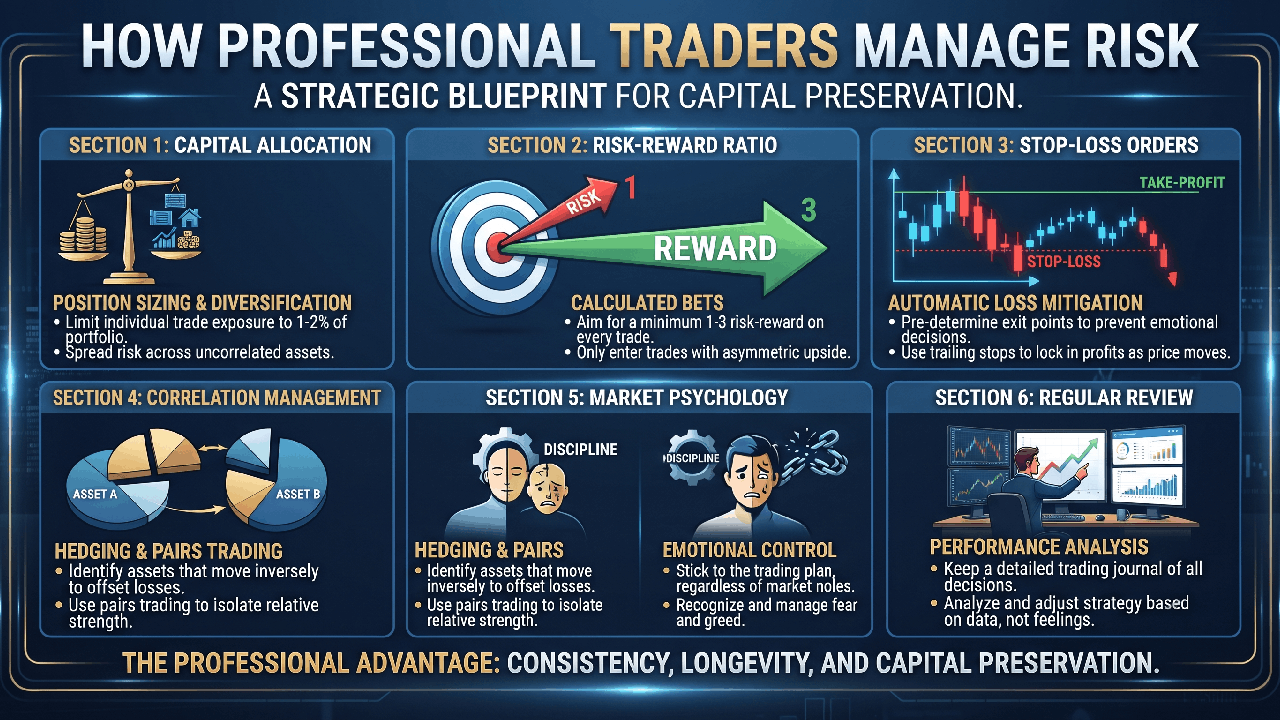
Successful trading is not only about finding profitable opportunities. One of the most important aspects of trading is managing risk effectively. Professional traders understand that losses are a normal part of trading. Instead of trying to eliminate every losing trade, they focus on controlling how much they can lose and maintaining a consistent process.
Here are some important risk-management principles used by professional traders.
1. They Define Risk Before Entering a Trade
Professional traders generally know their potential loss before placing an order.
Before entering a position, they may determine:
- Entry price
- Stop-loss level
- Target or exit conditions
- Position size
- Maximum acceptable loss
- Risk-to-reward relationship
This helps prevent decisions from being made emotionally after a trade is already open.
2. Position Sizing Is Important
Position sizing determines how much capital is allocated to a particular trade.
For example, a trader with a ₹1,00,000 trading account may decide to risk only a small portion of the account on a single setup.
The amount of capital committed should take into account the distance between the entry price and the planned stop-loss.
A smaller position can allow a trader to maintain the same predefined risk even when the stop-loss needs to be placed farther away.
3. Stop-Losses Can Limit Potential Losses
A stop-loss is an order or predefined exit level intended to limit a position’s loss if the market moves against the trader.
For example, if a trader buys a stock at ₹500 and establishes a stop-loss at ₹480, the planned risk based on price movement is ₹20 per share, before considering costs and execution differences.
However, stop-losses do not guarantee an exact exit price. During fast-moving or illiquid markets, execution can differ from the expected level.
4. They Avoid Overleveraging
Leverage allows traders to control a larger position with a smaller amount of capital.
While leverage can increase potential returns, it can also increase potential losses.
Professional risk management therefore considers:
- Position size
- Margin requirements
- Volatility
- Maximum exposure
- Potential drawdowns
Using excessive leverage can cause a relatively small market movement to produce a disproportionately large loss.
5. Risk-to-Reward Is Considered
Many traders compare the potential loss of a trade with its potential gain.
For example:
Potential risk: ₹1,000
Potential reward: ₹2,000
This represents a 1:2 risk-to-reward relationship.
However, a favorable risk-to-reward ratio does not automatically make a strategy profitable. The quality of the trading setup, probability of success, transaction costs, and actual execution also matter.
6. They Diversify Where Appropriate
Diversification can reduce concentration in a single asset, sector, or market.
For example, having exposure to several unrelated assets may reduce the impact of one individual position performing poorly.
However, diversification does not eliminate risk. Assets that appear different can sometimes move together during periods of market stress.
7. They Understand Drawdowns
A drawdown measures the decline in an account or portfolio from a previous peak.
For example:
- Starting capital: ₹1,00,000
- Account peak: ₹1,20,000
- Current value: ₹1,08,000
The decline from the peak is ₹12,000, or 10%.
Monitoring drawdowns helps traders understand how their strategy performs during unfavorable periods.
8. They Don’t Chase Losses
One common mistake is increasing trade size after a loss in an attempt to recover the money quickly.
This can turn a normal losing trade into a much larger financial problem.
Professional risk management focuses on following predefined rules rather than changing position size because of frustration or emotional reactions.
9. They Consider Market Volatility
Markets do not move at the same speed every day.
During high-volatility periods, prices can move rapidly and trading ranges can become much larger.
Professional traders may adjust their:
- Position size
- Stop-loss distance
- Exposure
- Trading frequency
- Strategy selection
A strategy that works under low-volatility conditions may behave differently when volatility increases.
10. They Keep a Trading Journal
A trading journal can help traders evaluate their decisions over time.
A useful journal may record:
- Date and time
- Instrument
- Entry price
- Exit price
- Position size
- Stop-loss
- Reason for entering
- Reason for exiting
- Profit or loss
- Market conditions
- Mistakes or lessons
Reviewing this information can reveal recurring behavioral or strategic patterns.
11. They Focus on Consistency
Professional trading is generally based on a repeatable process rather than trying to make a large profit from one trade.
A trader may experience several losing trades even when following a valid strategy.
The objective of risk management is to ensure that individual losses remain manageable so that the trader can continue executing the strategy over a series of trades.
A Simple Risk-Management Example
Suppose a trader has a ₹2,00,000 account and decides that the maximum planned risk per trade is 1%.
Maximum planned risk:
₹2,00,000 × 1% = ₹2,000
If the planned stop-loss represents a potential loss of ₹20 per share, the position size based on that risk limit would be:
₹2,000 ÷ ₹20 = 100 shares
This is a simplified example. Real-world trading also involves brokerage, taxes, slippage, liquidity, gaps, and other costs or risks.
Common Risk-Management Mistakes
Even experienced traders can encounter risk-management problems. Common mistakes include:
- Trading with excessive leverage
- Increasing position size after losses
- Moving a stop-loss farther away without a predefined reason
- Taking too many correlated positions
- Ignoring market volatility
- Risking too much on one trade
- Trading without an exit plan
- Letting emotions override predefined rules