

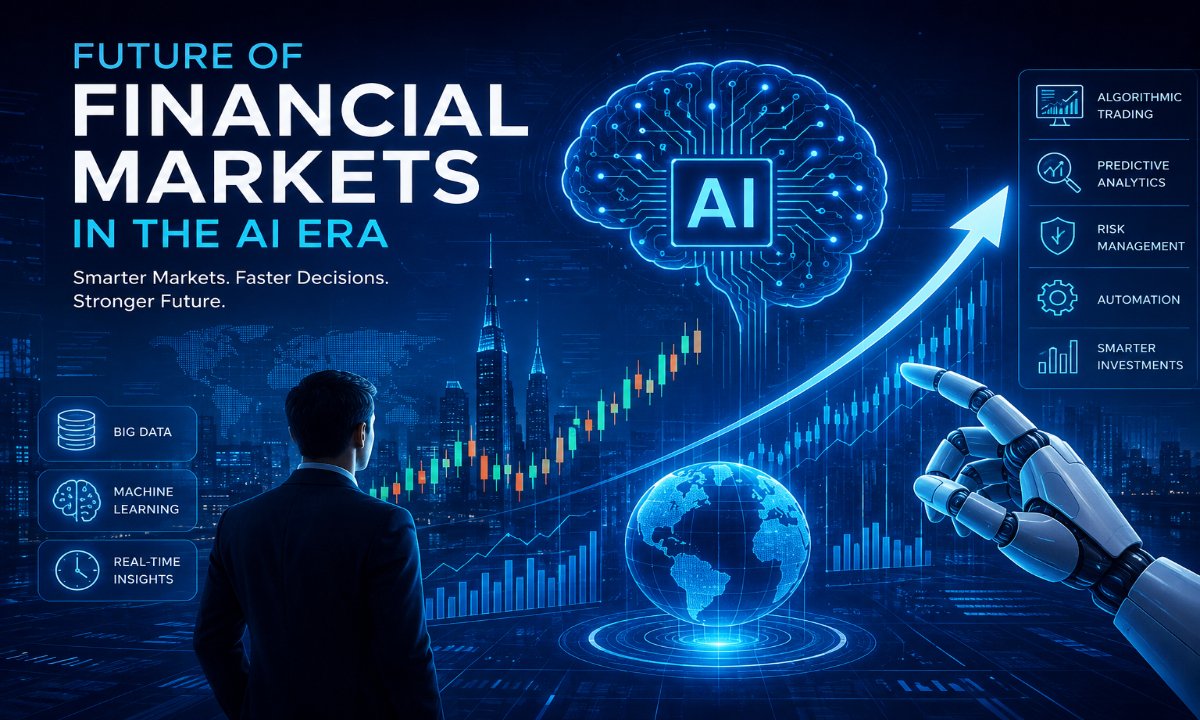
Artificial intelligence is rapidly transforming the financial industry. From algorithmic trading and fraud detection to personalized investment platforms and automated financial analysis, AI is changing how financial markets operate.
As AI technology becomes more advanced, financial markets are likely to become faster, more data-driven, and increasingly automated. At the same time, new challenges involving cybersecurity, regulation, transparency, and market stability will become more important.
How AI Is Changing Financial Markets
AI can process enormous amounts of financial information in a fraction of the time required by humans. This capability is already influencing several areas of finance.
1. AI-Powered Trading
AI systems can analyze historical prices, market trends, trading volume, technical indicators, and other data to identify potential trading opportunities.
Automated trading systems can also execute trades according to predefined strategies, reducing the need for manual intervention.
2. Smarter Investment Decisions
AI-powered investment platforms can analyze an investor’s objectives, risk tolerance, portfolio composition, and market conditions.
This can help investors discover potential opportunities and understand portfolio risks more efficiently.
However, AI-generated recommendations should be treated as analytical assistance rather than guaranteed investment advice.
3. Real-Time Market Analysis
Financial markets generate huge volumes of information every second.
AI can analyze market data, news, financial reports, and other signals in real time. This may help traders and institutions react more quickly to changing market conditions.
4. Fraud Detection
AI is becoming increasingly useful for identifying unusual transaction patterns.
Financial institutions can use machine learning models to detect potentially suspicious activity and flag transactions for further investigation.
5. Personalized Financial Services
AI can help financial platforms provide more personalized experiences.
In the future, investors may receive customized market insights, portfolio analysis, educational content, and risk information based on their individual needs.
AI and the Rise of Data-Driven Finance
Data is becoming one of the most valuable resources in modern financial markets.
Traditional financial analysis often relied heavily on historical financial statements, economic indicators, and technical analysis. AI can combine these sources with much larger datasets.
For example, an AI system could potentially analyze:
- Market prices
- Trading volume
- Economic indicators
- Company financial data
- News and market sentiment
- Historical trends
- Volatility
- Alternative datasets
The ability to combine multiple sources of information could make financial analysis more sophisticated and efficient.
Will AI Replace Human Traders?
AI is likely to automate many repetitive financial tasks, but completely replacing humans is a different question.
Human professionals can provide judgment, creativity, strategic thinking, and contextual understanding. AI, meanwhile, can process information quickly and consistently.
The future may therefore involve human-AI collaboration rather than complete replacement.
A trader might use AI to scan thousands of assets and identify potential setups, while the human decides whether the opportunity fits their strategy and risk tolerance.
The Role of AI in Risk Management
One of the most important applications of AI could be risk management.
AI systems can monitor portfolios and markets continuously, potentially identifying unusual patterns or rapidly changing risk conditions.
Financial institutions may use AI to:
- Monitor market exposure
- Detect unusual transactions
- Identify potential credit risks
- Analyze portfolio volatility
- Conduct scenario analysis
- Improve fraud detection
Better risk analysis could help financial institutions respond faster to potential problems.
Challenges of AI in Financial Markets
AI also creates significant challenges.
Lack of Transparency
Some advanced AI models can be difficult to understand. If an algorithm makes an important financial decision, users may want to know why that decision was made.
Algorithmic Bias
AI models depend on their training data. Poor-quality or biased data can produce unreliable results.
Cybersecurity
As financial systems become more dependent on AI and automation, protecting these systems from cyberattacks will become increasingly important.
Market Volatility
If many automated systems respond to the same market signals at the same time, their actions could potentially amplify market movements.
Regulatory Challenges
Regulators will need to develop frameworks that encourage innovation while protecting investors and maintaining financial stability.
What Will Financial Markets Look Like in the Future?
The financial markets of the future could become increasingly automated and intelligent.
Investors may use AI assistants to analyze portfolios, compare financial products, understand market trends, and identify potential risks.
Trading platforms may offer more advanced automation tools, while financial institutions may use AI across trading, lending, fraud prevention, customer service, and compliance.
At the same time, human oversight will remain important. Financial decisions involve uncertainty, and no AI system can guarantee accurate predictions of future market movements.
AI and the Democratization of Finance
One of the biggest potential benefits of AI is increased access to sophisticated financial technology.
Tools that were previously available mainly to large financial institutions could become accessible to individual investors through affordable online platforms.
This could help more people access:
- Advanced market analysis
- Portfolio monitoring
- Automated research
- Risk-management tools
- Financial education
- Personalized insights
However, easier access also increases the importance of financial literacy. Investors need to understand the limitations of AI before relying on its recommendations.
Final Thoughts
The future of financial markets will likely be shaped by a combination of artificial intelligence, automation, big data, and human expertise.
AI can make financial analysis faster and more efficient, but it cannot eliminate uncertainty from investing and trading.
The winners of the AI era may not simply be those who use the most advanced technology. They may be the individuals and institutions that understand when to use AI, how to evaluate its output, and how to manage the risks associated with it.
As AI continues to evolve, financial markets are likely to become more intelligent, automated, and data-driven—creating both exciting opportunities and new responsibilities for the next generation of investors and financial professionals.