

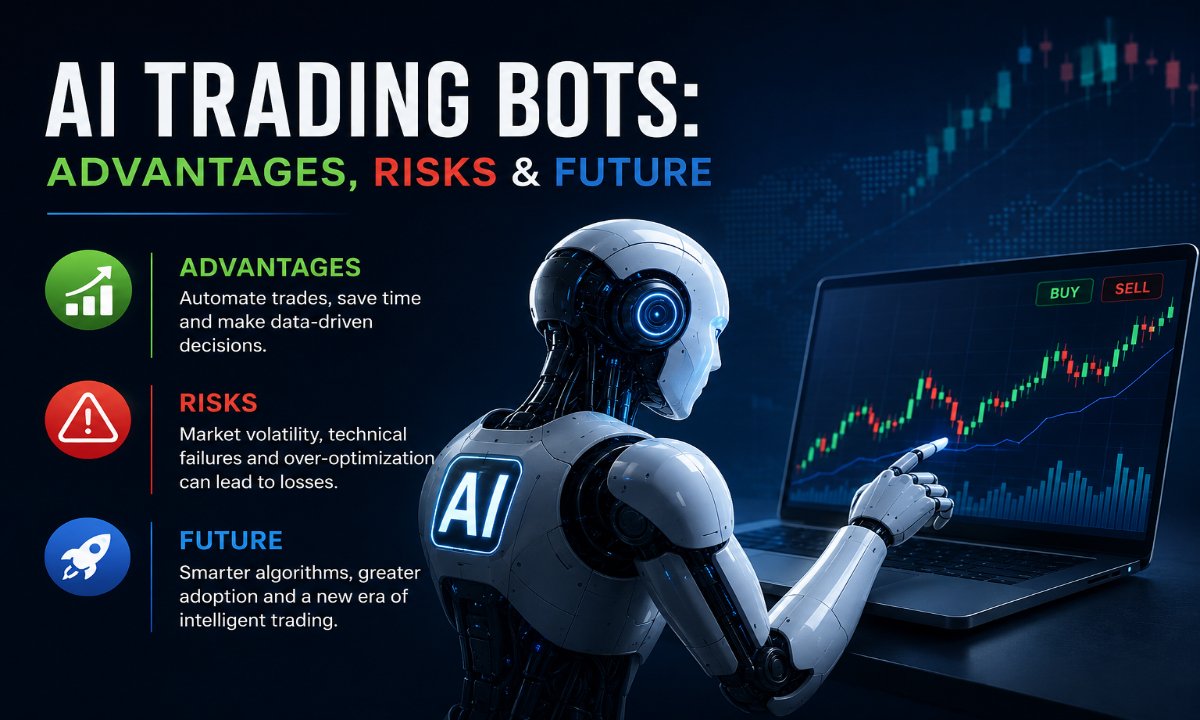
Artificial intelligence is transforming the way people analyze financial markets and make trading decisions. One of the most talked-about developments is the rise of AI trading bots—software programs that use algorithms, machine learning, market data, and predefined strategies to identify trading opportunities and sometimes execute trades automatically.
AI trading bots can help traders save time, analyze large amounts of data, and reduce emotional decision-making. However, they are not guaranteed to make profits. Market volatility, incorrect strategies, poor data, technical failures, and unexpected events can all lead to losses.
In this article, we will explore how AI trading bots work, their advantages and risks, and what their future could look like.
What Are AI Trading Bots?
AI trading bots are automated software systems designed to analyze financial markets and assist with or execute trading decisions. Depending on the system, a bot may analyze factors such as:
- Price movements
- Trading volume
- Technical indicators
- Historical market data
- Market trends
- News and sentiment
- Volatility
- Risk parameters
Traditional trading bots generally follow fixed rules. AI-powered bots can go further by using machine learning or other AI techniques to identify patterns in data and adjust their analysis.
For example, a bot may monitor a market continuously and identify a potential trading setup based on a combination of price trends, volume, and technical indicators. If the system is configured for automated execution, it can place an order according to predefined risk rules.
How Do AI Trading Bots Work?
An AI trading bot typically follows several stages:
1. Data Collection
The bot collects market information from sources such as exchanges, broker platforms, price feeds, and other financial data providers.
2. Data Analysis
AI algorithms process large amounts of information to identify patterns, trends, and potential trading signals.
3. Strategy Generation
The system applies a trading strategy to determine whether market conditions meet specific criteria.
4. Risk Management
Some systems can automatically apply rules involving position size, stop-loss levels, maximum exposure, and other risk controls.
5. Trade Execution
If the bot is connected to a compatible trading platform and configured for automated execution, it can place trades without requiring manual intervention.
6. Monitoring and Optimization
More advanced systems can evaluate historical performance and adjust certain parameters. However, optimization must be handled carefully because excessive adjustment can cause a strategy to perform well on historical data but poorly in real markets.
Advantages of AI Trading Bots
1. Faster Market Analysis
Financial markets generate enormous amounts of data. AI trading systems can process information much faster than a human trader.
This can help traders identify potential opportunities without manually checking charts and indicators continuously.
2. Reduced Emotional Trading
Fear, greed, impatience, and overconfidence can influence trading decisions.
Because automated systems follow predefined rules, they can reduce some forms of emotional decision-making. However, the quality of the rules still depends on how the system was designed.
3. 24/7 Market Monitoring
Some financial markets operate around the clock. An automated system can monitor markets continuously, allowing traders to track opportunities even when they are away from their computers.
4. Consistent Execution
Human traders may hesitate or change their decisions during volatile market conditions. A properly configured bot can follow its programmed strategy consistently.
5. Backtesting
Many trading systems allow strategies to be tested against historical market data.
Backtesting can help traders understand how a strategy might have performed historically. However, historical performance does not guarantee future results.
6. Efficient Data Processing
AI systems can analyze multiple variables simultaneously. This can be useful when traders want to combine technical indicators, market statistics, sentiment data, and other inputs.
Risks of AI Trading Bots
Despite their advantages, AI trading bots come with significant risks.
1. No Guaranteed Profits
The biggest misconception is that an AI trading bot can guarantee profits.
Financial markets are unpredictable. A strategy that performs well under certain conditions can fail when market conditions change.
2. Poor Strategy Design
AI does not automatically create a successful trading strategy. If the underlying strategy is weak, the bot may simply automate poor decisions faster.
3. Overfitting
A model can sometimes become too closely optimized for historical data.
This is known as overfitting. A strategy may show excellent backtesting results but perform poorly when exposed to new market conditions.
4. Technical Failures
Trading bots depend on software, internet connections, APIs, servers, and trading platforms.
Technical problems can potentially result in delayed orders, incorrect execution, or unexpected positions.
5. Market Volatility
Sudden market movements caused by economic announcements, geopolitical events, unexpected news, or liquidity changes can create conditions that an AI model was not designed to handle.
6. Security Risks
Connecting a trading bot to an exchange or broker account can create cybersecurity concerns.
Traders should carefully review API permissions, account security, authentication methods, and the reputation of the software provider.
7. Lack of Human Judgment
AI can analyze data, but it does not possess human judgment in the same way a professional trader does.
Unexpected events can require decisions that are difficult to encode into a trading algorithm.
AI Trading Bots vs Human Traders
AI and human traders have different strengths.
| AI Trading Bots | Human Traders |
|---|---|
| Process data quickly | Understand broader context |
| Follow predefined rules | Adapt based on judgment |
| Monitor markets continuously | Can interpret unusual situations |
| Reduce some emotional decisions | Can understand qualitative information |
| Execute trades automatically | Maintain direct control |
| Perform systematic backtesting | Can question whether a strategy makes sense |
The future may not necessarily be about AI versus humans. Instead, successful traders may increasingly combine human judgment with AI-powered analysis and automation.
How Beginners Should Approach AI Trading Bots
Beginners should avoid treating AI trading bots as automatic money-making machines.
A better approach is to:
- Learn basic trading concepts first.
- Understand how the bot’s strategy works.
- Test strategies using historical data.
- Use paper trading or a demo environment when available.
- Start with limited capital if moving to live trading.
- Set clear risk-management rules.
- Monitor performance regularly.
- Avoid systems promising guaranteed returns.
- Understand fees, spreads, and execution costs.
- Never invest money that you cannot afford to lose.
The goal should be to understand the technology rather than blindly trusting it.
The Future of AI Trading Bots
The future of AI trading is likely to involve more advanced data analysis, machine learning, automation, and personalized trading tools.
Future systems may become better at processing multiple forms of information, including market data, financial reports, news, and sentiment.
AI could also make sophisticated analytical tools more accessible to individual traders who previously needed expensive technology or professional teams.
However, regulation, cybersecurity, transparency, data quality, and risk management will become increasingly important as AI-powered trading becomes more widespread.
The most valuable development may not be fully autonomous trading. Instead, AI could increasingly act as an intelligent trading assistant, helping users analyze markets, identify potential setups, evaluate risk, and make better-informed decisions.
Final Thoughts
AI trading bots have the potential to change the way people participate in financial markets. They can provide faster analysis, automated execution, continuous monitoring, and systematic decision-making.
But AI is not a shortcut to guaranteed wealth. Markets remain uncertain, and even sophisticated algorithms can fail.