

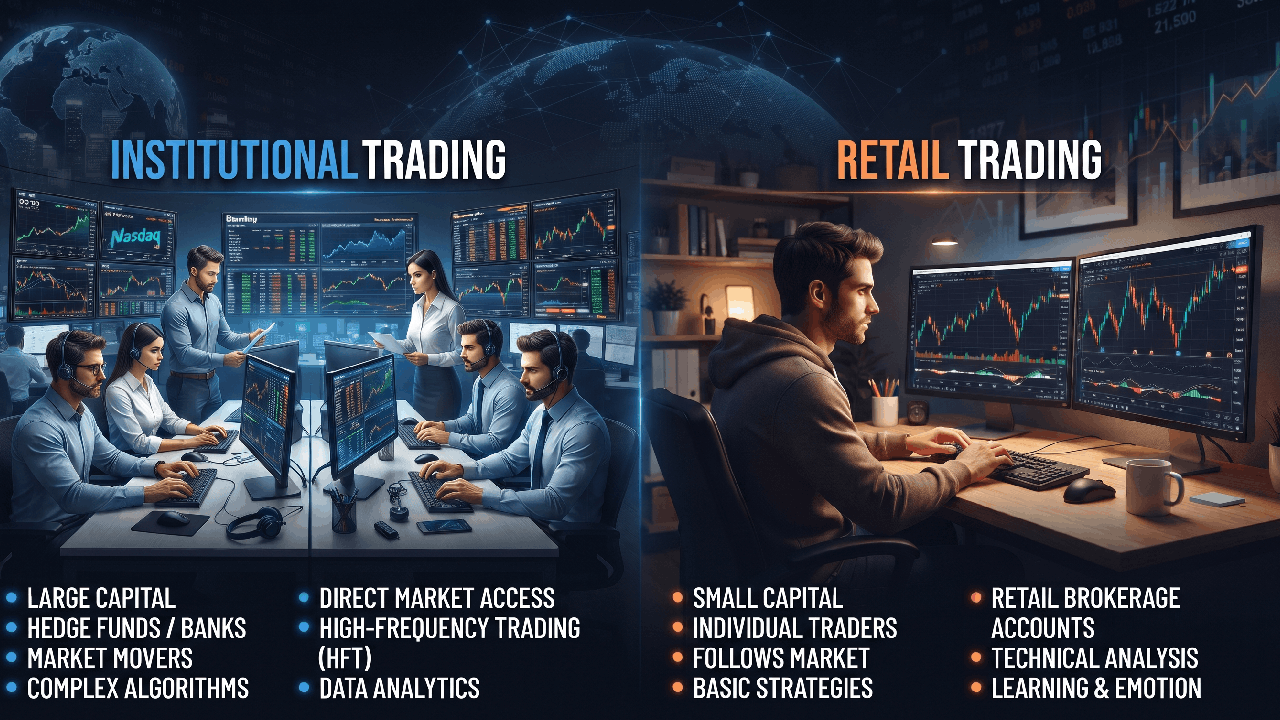
The financial markets are made up of different types of participants. Two major groups are institutional traders and retail traders. While both participate in the same markets, they often differ significantly in terms of capital, technology, objectives, research, and execution methods. Understanding these differences can help beginners develop a better understanding of how financial markets operate.
What Is Institutional Trading?
Institutional trading refers to trading activity carried out by large organizations and professional financial institutions.
Examples include:
- Mutual funds
- Pension funds
- Insurance companies
- Hedge funds
- Investment banks
- Asset management firms
- Proprietary trading firms
These institutions can manage very large amounts of capital and may execute substantial transactions across stocks, bonds, derivatives, currencies, and other financial instruments.
Because of their size, institutional orders can sometimes have a noticeable impact on market liquidity and price movements.
What Is Retail Trading?
Retail trading refers to trading carried out by individual investors using their personal capital.
Retail traders commonly participate through online brokerage platforms and may trade:
- Stocks
- ETFs
- Index derivatives
- Commodities
- Forex
- Cryptocurrencies
Retail traders generally operate with much smaller positions compared with large financial institutions.
They may make decisions using technical analysis, fundamental analysis, news, market data, or a combination of different approaches.
Institutional Trading vs Retail Trading
| Factor | Institutional Trading | Retail Trading |
|---|---|---|
| Participants | Financial institutions and professional firms | Individual traders and investors |
| Capital | Usually very large | Usually smaller |
| Research | Dedicated research teams and analysts | Individual research or external resources |
| Technology | Advanced trading systems and infrastructure | Brokerage platforms and personal tools |
| Execution | Sophisticated execution strategies | Generally simpler order execution |
| Market Impact | Large orders can potentially affect liquidity and prices | Usually limited individual market impact |
| Objectives | Investment, portfolio management, hedging, or trading strategies | Investing, trading, income, or capital growth |
| Risk Management | Often structured at portfolio and institutional levels | Depends on the individual’s strategy and discipline |
How Do Institutions Trade Large Positions?
One important challenge for institutions is order size.
Suppose an institution wants to buy a very large number of shares. Executing the entire order at once could significantly affect the available liquidity and potentially increase the purchase price.
To manage this, professional traders may use different execution techniques, including:
- Breaking large orders into smaller transactions
- Using algorithmic execution
- Trading across multiple venues where appropriate
- Monitoring liquidity and market conditions
- Using derivatives for hedging or exposure management
The exact method depends on the institution, asset, market conditions, and trading objective.
Do Institutions Always Control the Market?
Not necessarily.
Institutional investors represent a significant portion of financial-market activity, but markets are influenced by many participants and factors.
Price movements can be affected by:
- Institutional transactions
- Retail activity
- Economic data
- Corporate earnings
- Interest-rate expectations
- Geopolitical developments
- Market sentiment
- Liquidity conditions
- Unexpected news
Therefore, it is important not to assume that every large price movement is caused by a single institution or institutional order.
Why Retail Traders Study Institutional Activity
Some retail traders attempt to understand institutional behavior by analyzing:
- Trading volume
- Market structure
- Support and resistance
- Volume profiles
- Price reactions around important levels
- Open interest in derivatives
- Order-flow data, where available
The idea is to understand where significant buying or selling interest may exist.
However, these tools generally cannot identify the exact institution behind a particular price movement unless reliable transaction-level information explicitly provides that information.
Technology Difference
Technology is another major distinction.
Large institutions may have access to sophisticated systems for:
- Market-data processing
- Algorithmic trading
- Risk monitoring
- Portfolio management
- Order execution
- Quantitative research
Retail traders typically use brokerage platforms, charting software, financial websites, and other commercially available tools.
However, technology alone does not guarantee trading success. Strategy, risk management, costs, execution, and market conditions remain important.
Risk Management: A Major Difference
Institutions typically manage risk across portfolios rather than looking at a single trade in isolation.
They may use techniques such as:
- Diversification
- Hedging
- Position limits
- Derivatives
- Exposure monitoring
- Stop-loss or other risk controls
- Stress testing
Retail traders can also apply many basic risk-management principles.
For example, a trader might determine the maximum amount they are willing to risk before entering a position and adjust their position size accordingly.
Institutional Trading and Retail Trading Can Coexist
Institutional and retail traders are not necessarily competing directly on every trade.
Financial markets bring together participants with different objectives.
An institution may be investing for long-term portfolio growth, while another participant may be hedging risk. A retail trader may be looking for a short-term opportunity, while another individual may be investing for several years.
These different objectives contribute to market liquidity and price discovery.
What Can Retail Traders Learn?
Retail traders cannot replicate every aspect of institutional trading, particularly when it comes to capital, infrastructure, and access to certain resources.
However, they can learn from some professional principles:
1. Focus on Risk First
Protecting capital is an important part of long-term participation in financial markets.
2. Follow a Trading Plan
Clearly define entry conditions, exit conditions, position size, and risk before trading.
3. Avoid Emotional Decisions
Fear, greed, and overconfidence can influence decision-making. A systematic process can help reduce impulsive trades.
4. Understand Liquidity
Knowing how liquidity can affect execution and price movement can improve market awareness.
5. Keep Learning
Markets change over time. Reviewing trades and learning from both successful and unsuccessful decisions can help develop trading discipline.