

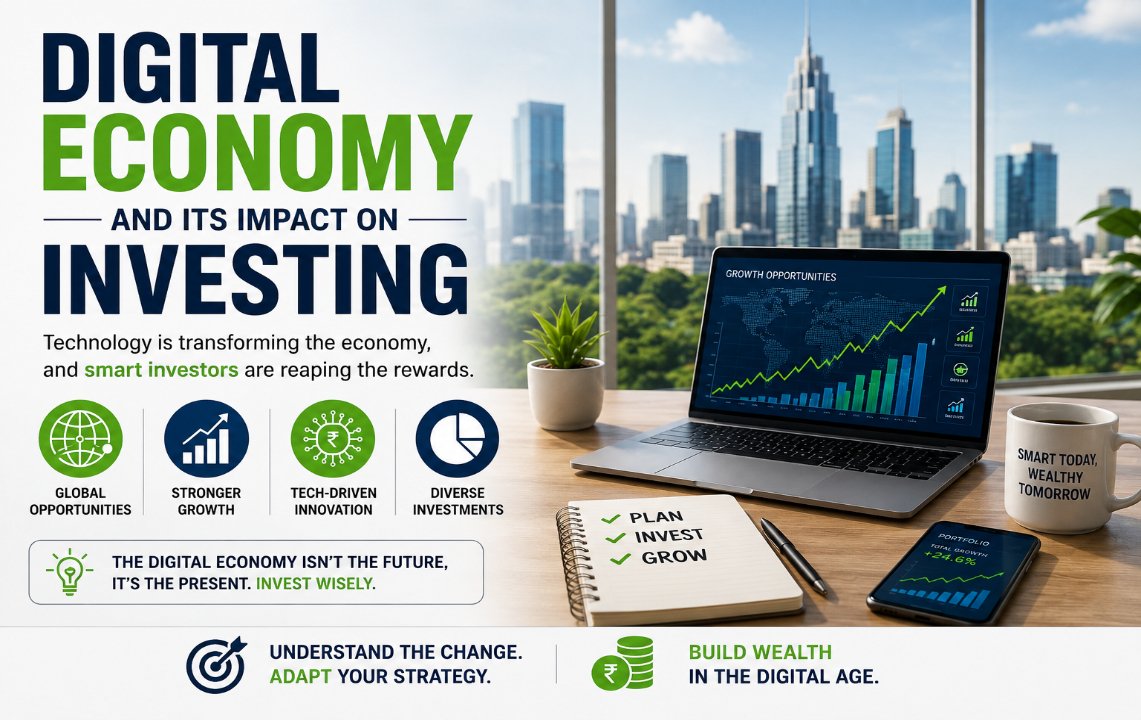
The way people earn, spend, save, and invest money is changing rapidly.
The rise of smartphones, digital payments, e-commerce, fintech platforms, artificial intelligence, cloud computing, and online businesses has created a new economic environment commonly known as the digital economy.
This transformation is not only changing how businesses operate—it is also changing how investors identify opportunities, evaluate companies, and manage investments.
From digital banking and online brokerages to artificial intelligence and fintech startups, the digital economy has created entirely new investment themes while transforming traditional industries.
So, what exactly is the digital economy, and how is it affecting investing?
Let’s explore.
What Is the Digital Economy?
The digital economy refers to economic activity that relies heavily on digital technologies, internet connectivity, data, and digital platforms.
It includes sectors such as:
- E-commerce
- Fintech
- Digital banking
- Cloud computing
- Artificial intelligence
- Software and SaaS
- Digital payments
- Online education
- Cybersecurity
- Digital entertainment
- Data and analytics
- Online marketplaces
Companies don’t necessarily need to operate entirely online to be part of the digital economy. Traditional businesses are also adopting digital technologies to improve efficiency, reach customers, reduce costs, and create new revenue streams.
How the Digital Economy Is Changing Investing
Technology has made investing significantly more accessible.
Earlier, investors often depended on brokers, newspapers, television channels, and physical paperwork to access market information and execute transactions.
Today, investors can:
- Open investment accounts online
- Buy and sell securities through mobile apps
- Track portfolios in real time
- Access company financial information online
- Use analytical tools
- Follow global markets
- Automate investments
- Learn about markets through online education
This increased accessibility has brought investing closer to everyday consumers.
However, easier access also means investors need stronger financial knowledge and discipline.
Digital Payments Are Creating New Investment Opportunities
The growth of digital payments has transformed consumer behavior.
Businesses can now accept payments electronically, while consumers can transfer money almost instantly using digital payment systems.
This creates opportunities for companies involved in:
- Payment processing
- Financial technology
- Digital banking
- Cybersecurity
- Financial infrastructure
- E-commerce
For investors, the growth of digital transactions can become an important trend to monitor when evaluating companies and industries.
Artificial Intelligence Is Creating a New Investment Theme
Artificial intelligence is one of the most significant technological developments affecting businesses and markets.
Companies are using AI for:
- Automation
- Customer service
- Data analysis
- Software development
- Marketing
- Fraud detection
- Manufacturing
- Healthcare
- Financial services
The investment impact goes beyond companies developing AI models.
AI can influence the entire technology ecosystem, including semiconductor manufacturers, cloud infrastructure providers, data-center businesses, cybersecurity companies, and software platforms.
Investors therefore need to look beyond the headline and understand which companies may actually benefit from AI adoption and whether their valuations justify the expectations.
Data Has Become an Important Economic Asset
In the digital economy, data plays a major role.
Businesses collect and analyze information about customers, products, transactions, operations, and market behavior.
Data can help companies:
- Understand customers
- Improve products
- Personalize marketing
- Predict demand
- Reduce operational costs
- Detect fraud
- Make faster decisions
For investors, a company’s ability to effectively use data can become an important part of understanding its competitive advantage.
Digital Transformation Is Affecting Traditional Companies Too
The digital economy isn’t limited to technology companies.
Banks, retailers, manufacturers, logistics companies, automobile companies, healthcare businesses, and other traditional industries are investing heavily in digital transformation.
For example, a traditional retailer may adopt:
- E-commerce
- Digital payments
- Customer analytics
- Automated inventory systems
- Online marketing
A bank may introduce:
- Mobile banking
- Digital account opening
- AI-powered fraud detection
- Automated customer service
Therefore, investors should evaluate how effectively a company is adapting to technological change, not simply whether it belongs to the technology sector.
Investing Has Become More Data-Driven
Technology has dramatically increased the amount of information available to investors.
Investors can analyze:
- Financial statements
- Historical prices
- Trading volumes
- Company announcements
- Industry data
- Economic indicators
- Market trends
Analytical software and AI-powered tools can also help investors process large amounts of information.
But more information does not automatically mean better decisions.
The quality of analysis matters more than the quantity of information.
Investors still need to understand the underlying business, financial performance, valuation, and risks.
The Rise of Retail Investors
Digital platforms have lowered many of the barriers that previously existed in investing.
A person with a smartphone and internet connection can access financial markets much more easily than in the past.
This has contributed to greater participation from retail investors.
However, easy access can also encourage emotional decisions.
Investors may be influenced by:
- Social-media trends
- Market rumors
- Influencers
- Fear of missing out
- Short-term price movements
- Viral investment ideas
This makes financial education and risk management more important than ever.
Cybersecurity Is Becoming an Investment Consideration
As more economic activity moves online, cybersecurity becomes increasingly important.
Businesses need to protect:
- Customer information
- Financial transactions
- Digital infrastructure
- Intellectual property
- Internal systems
Cybersecurity spending is therefore becoming an important business requirement.
From an investment perspective, companies providing cybersecurity products and services may benefit from increasing demand.
At the same time, investors should consider cybersecurity risks when evaluating any digital business.
The Digital Economy Also Creates New Risks
The digital economy creates opportunities, but it also introduces new risks.
Some important risks include:
Technology Risk
A company may depend heavily on technology that becomes outdated.
Cybersecurity Risk
Data breaches and cyberattacks can damage a company’s reputation and finances.
Regulatory Risk
Governments may introduce new rules governing data, AI, digital payments, or online platforms.
Valuation Risk
Popular technology companies can sometimes trade at valuations that already reflect very high future expectations.
Competition
Technology markets can change quickly, and today’s market leader may face significant competition tomorrow.
Understanding these risks is essential before making an investment decision.
How Investors Can Adapt to the Digital Economy
Investors don’t need to become technology experts.
However, they should develop the ability to understand major technological trends and their potential business impact.
A practical approach is to:
1. Learn the technology trend
Understand what the technology actually does.
2. Identify the business impact
Ask how it can affect revenue, costs, productivity, or competitive advantage.
3. Study the company
Examine financial performance, management, debt, profitability, and business model.
4. Evaluate valuation
A great company isn’t necessarily a great investment at any price.
5. Understand the risks
Consider competition, regulation, cybersecurity, and technological disruption.
6. Avoid hype-driven decisions
Don’t invest simply because a company or technology is trending online.
Digital Economy and the Future of Investing
The digital economy is likely to remain a major force shaping businesses and financial markets.
Artificial intelligence, automation, cloud computing, digital payments, cybersecurity, and other technologies are changing how companies operate.
For investors, this creates both new opportunities and new challenges.
The most successful investors may not necessarily be the ones who predict every new technology.
Instead, they may be the ones who can understand how technological change affects businesses, earnings, competitive advantages, and valuations.
Final Thoughts
The digital economy has fundamentally changed the investment landscape.
Investing is becoming more accessible, information is becoming more abundant, and technology is creating new industries and transforming existing ones.
But technology alone doesn’t guarantee investment success.