

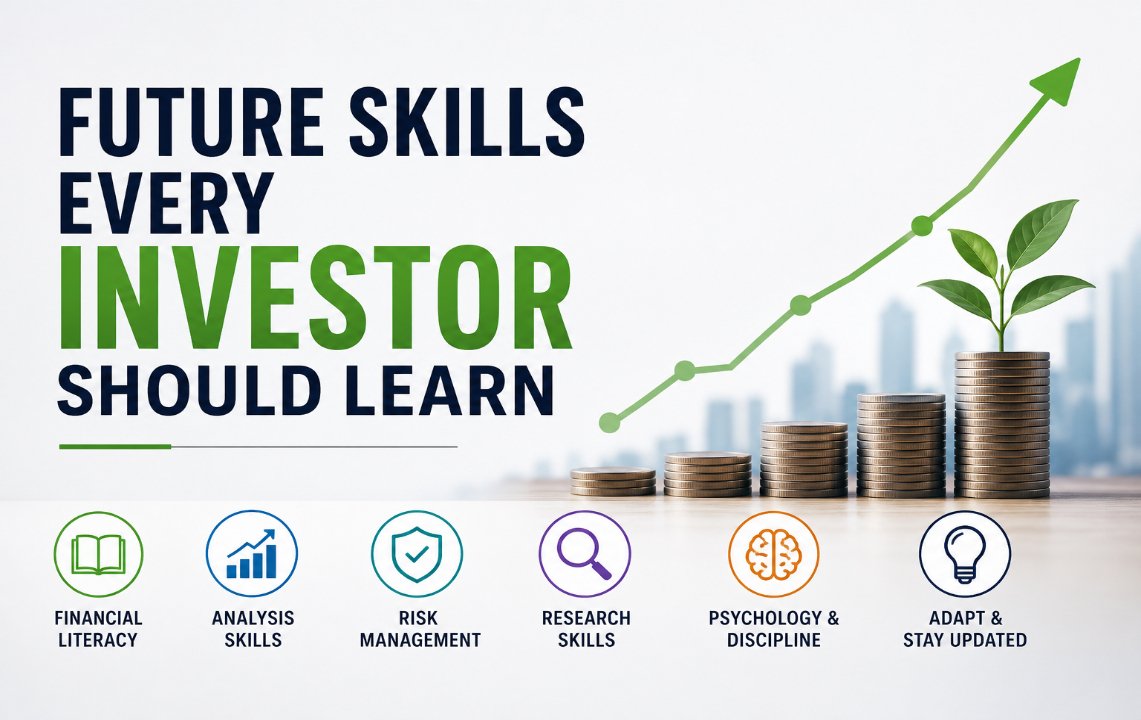
The investment world is changing rapidly. Technology, artificial intelligence, data analytics, automation, and global economic changes are transforming how people research and manage investments. In this environment, successful investors will need more than traditional market knowledge.
The future of investing will depend on a combination of financial knowledge, technology skills, critical thinking, and risk management.
1. Financial Literacy
Financial literacy will remain the foundation of successful investing. Investors should understand important concepts such as stocks, bonds, mutual funds, ETFs, inflation, interest rates, compounding, valuation, and taxation.
A strong financial foundation helps investors make informed decisions instead of relying on market hype or social media trends.
2. AI and Technology Skills
Artificial intelligence is becoming an increasingly important part of financial research. AI tools can help investors organize information, analyze large amounts of data, identify patterns, and summarize financial reports.
However, AI should be treated as a supporting tool rather than a replacement for human judgment. Investors still need to verify information and understand the risks behind an investment decision.
3. Data Analysis
Modern markets generate enormous amounts of financial and economic data. Learning how to interpret charts, company financial statements, earnings reports, valuation metrics, and market indicators can give investors a significant advantage.
Basic knowledge of spreadsheets and data analysis tools can help investors compare companies and track portfolio performance more effectively.
4. Critical Thinking
One of the most valuable future investment skills will be the ability to question information.
Investors are constantly exposed to headlines, predictions, influencers, advertisements, and market rumors. Instead of immediately believing a claim, investors should ask:
- What is the source?
- Is there reliable evidence?
- What are the risks?
- Does the information support the investment thesis?
- Could there be another explanation?
Critical thinking can help investors avoid emotional and impulsive decisions.
5. Risk Management
Making money is only one part of investing. Protecting capital is equally important.
Future investors should understand diversification, position sizing, asset allocation, volatility, drawdowns, and risk-reward relationships. A well-designed portfolio should consider both potential returns and the amount of risk an investor can realistically tolerate.
6. Understanding Global Markets
Markets are increasingly connected. Events in one country can affect currencies, commodities, interest rates, businesses, and stock markets around the world.
Investors should develop a basic understanding of global economic factors such as central-bank policies, inflation, geopolitical developments, commodity prices, and international trade.
7. Cybersecurity and Digital Safety
As investing becomes more digital, protecting financial accounts will become increasingly important.
Investors should learn basic cybersecurity practices such as using strong passwords, enabling two-factor authentication, avoiding suspicious links, and verifying investment platforms before transferring money.
Digital security is now part of responsible investing.
8. Emotional Discipline
Technology can provide information quickly, but it cannot eliminate human emotions.
Fear, greed, overconfidence, and the fear of missing out can lead investors to make poor decisions. Developing patience and sticking to a well-defined investment strategy can be more valuable than constantly reacting to market movements.
9. Continuous Learning
Financial markets never remain exactly the same. New technologies, industries, regulations, investment products, and economic conditions continue to emerge.
Successful investors should develop a habit of continuous learning by reading financial reports, studying market history, following economic developments, and reviewing their own investment decisions.
10. Understanding Automation
Automation is changing the way people invest. Automated portfolio management, recurring investments, algorithmic analysis, and digital financial platforms can make investing more convenient.
Understanding how these systems work—and their limitations—will help investors use automation effectively without blindly depending on it.
The Future Investor Will Be More Than a Stock Picker
The investor of the future will need to combine financial knowledge with technology, data analysis, risk management, and critical thinking.
The goal is not to predict every market movement. Instead, it is to build the skills necessary to make better decisions when markets are uncertain.
Final Thoughts
The investment landscape of the future will belong to people who are willing to adapt and keep learning. AI may change how information is analyzed, technology may make investing easier, and data may become even more important—but human judgment, discipline, and risk awareness will remain essential.