

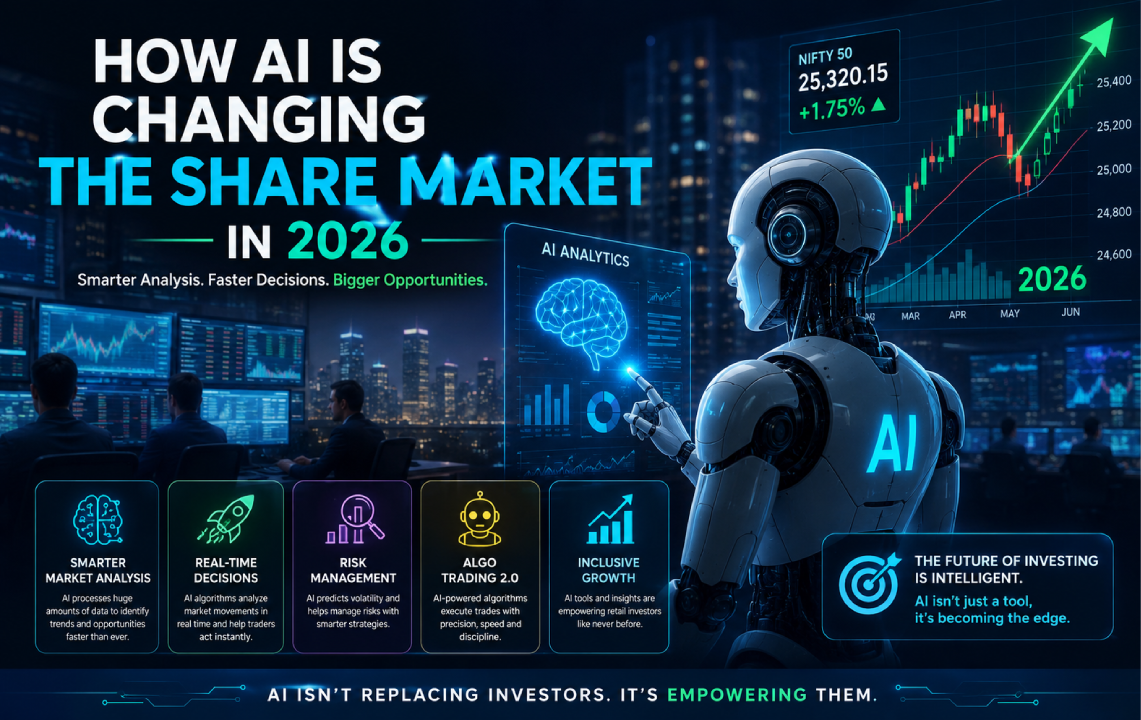
Artificial Intelligence (AI) is no longer a futuristic concept—it has become a powerful force reshaping industries worldwide, and the share market is no exception. In 2026, AI is playing a crucial role in how investors analyze stocks, manage risks, and make investment decisions. From institutional investors to retail traders, AI-powered tools are transforming the way people interact with financial markets.
But how exactly is AI changing the share market, and what does it mean for investors? Let’s explore.
The Rise of AI in Financial Markets
Over the past few years, advancements in machine learning, big data analytics, and natural language processing have enabled AI systems to process vast amounts of financial information within seconds. These technologies help investors identify trends, predict market movements, and make data-driven decisions faster than ever before.
Today, AI is being used by hedge funds, investment firms, brokerage platforms, and individual traders to gain a competitive edge in the market.
AI-Powered Market Analysis
One of the biggest advantages of AI is its ability to analyze enormous volumes of data quickly and accurately.
AI systems can evaluate:
- Company financial statements
- Earnings reports
- Economic indicators
- Global market trends
- News articles
- Social media sentiment
- Historical stock performance
Instead of spending hours researching multiple sources, investors can receive insights generated by AI in real time.
Smarter Trading Strategies
In 2026, algorithmic trading powered by AI has become more sophisticated than ever. AI-driven trading systems can identify patterns and execute trades automatically based on predefined conditions.
Benefits include:
- Faster execution speeds
- Reduced emotional decision-making
- Improved market efficiency
- Continuous monitoring of market opportunities
Many professional traders now rely on AI algorithms to assist with decision-making and portfolio management.
Predictive Analytics and Forecasting
AI excels at recognizing patterns that humans may overlook. By analyzing historical data and market behavior, AI can generate forecasts about potential stock price movements.
While no technology can predict the market with complete accuracy, AI helps investors:
- Identify emerging trends
- Detect market anomalies
- Estimate risk levels
- Improve probability-based decision-making
This allows investors to make more informed choices rather than relying solely on intuition.
AI and Retail Investors
AI is no longer limited to large financial institutions. Retail investors now have access to AI-powered tools through trading platforms, investment apps, and financial websites.
Features commonly available include:
- Personalized investment recommendations
- Portfolio analysis
- Risk assessment tools
- Automated investment strategies
- Market alerts and insights
As a result, individual investors can access sophisticated technology that was once available only to professionals.
The Growth of Robo-Advisors
Robo-advisors have become increasingly popular in 2026. These AI-powered platforms help users build and manage investment portfolios based on their financial goals, risk tolerance, and investment horizon.
Advantages of robo-advisors include:
- Lower management fees
- Automated portfolio rebalancing
- Goal-based investing
- Accessibility for beginners
This technology is making investing more affordable and convenient for millions of people.
AI-Powered Sentiment Analysis
Market sentiment often influences stock prices. AI systems can analyze millions of online discussions, news reports, and social media posts to determine whether investor sentiment is positive, negative, or neutral.
This helps investors understand market psychology and anticipate potential reactions to major events.
For example, AI can quickly detect changes in public opinion following:
- Corporate announcements
- Economic policy changes
- Product launches
- Global events
Such insights can provide valuable context for investment decisions.
Improved Risk Management
Risk management remains one of the most important aspects of investing. AI helps investors identify potential threats before they become major problems.
AI systems can:
- Monitor portfolio exposure
- Detect unusual market activity
- Identify concentration risks
- Generate risk alerts in real time
This enables investors to take proactive measures and protect their investments.
Challenges and Limitations of AI
Despite its advantages, AI is not a magic solution.
Some challenges include:
Data Quality Issues
AI models are only as good as the data they receive. Inaccurate or incomplete data can lead to poor predictions.
Market Uncertainty
Unexpected events such as geopolitical crises, natural disasters, or regulatory changes can affect markets in ways that AI may not anticipate.
Over-Reliance on Automation
Investors should avoid blindly following AI recommendations without understanding the underlying logic and risks.
Ethical and Regulatory Concerns
As AI becomes more influential in financial markets, regulators continue to examine issues related to transparency, fairness, and accountability.
What the Future Holds
The integration of AI into financial markets is expected to accelerate in the coming years. Future developments may include:
- More advanced predictive models
- AI-driven portfolio optimization
- Enhanced fraud detection systems
- Real-time global market intelligence
- Personalized investment assistants
As technology continues to evolve, AI will likely become an essential tool for investors at every level.
Conclusion
In 2026, AI is transforming the share market by improving analysis, enhancing trading strategies, strengthening risk management, and making sophisticated investment tools accessible to everyone. While AI cannot eliminate market risks or guarantee profits, it provides investors with powerful insights that can support smarter decision-making.