

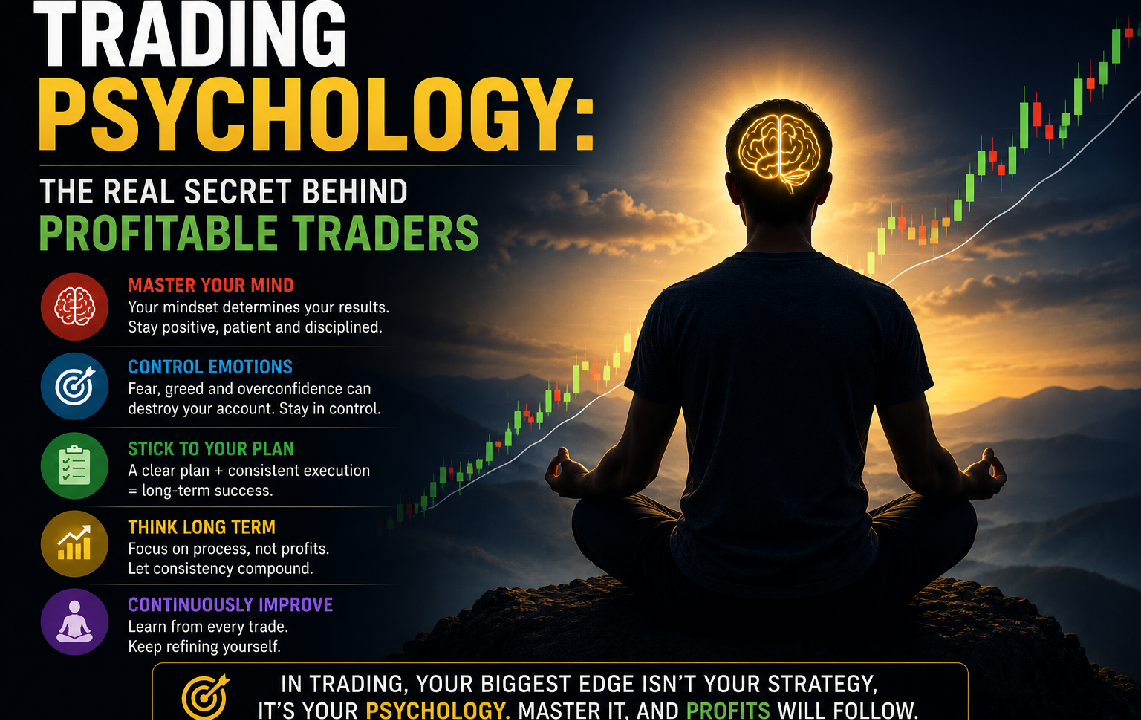
Why Mindset Matters More Than Strategy
Most new traders believe success in the stock market depends on finding the perfect strategy, indicator, or trading setup. While technical knowledge is important, experienced traders know that the real difference between consistent winners and losing traders often comes down to trading psychology.
In fact, many traders fail not because they lack market knowledge, but because they struggle to control their emotions. Fear, greed, impatience, and overconfidence can quickly turn a profitable strategy into a losing one.
This is why successful traders consider emotional discipline and mindset to be among the most important factors in long-term profitability.
What Is Trading Psychology?
Trading psychology refers to the mental and emotional state that influences trading decisions.
It includes:
- Emotional control
- Decision-making ability
- Risk tolerance
- Confidence management
- Patience and discipline
The stock market constantly tests a trader’s emotions. Prices move unpredictably, profits disappear quickly, and losses can occur even when a trade follows a solid plan.
How traders react to these situations often determines their success.
Why Emotions Affect Trading Performance
Financial markets involve uncertainty, and uncertainty naturally triggers emotional responses.
When money is at stake, traders often experience:
Fear
Fear usually appears when:
- A trade moves against expectations.
- Market volatility increases.
- Previous losses affect confidence.
Fear can cause traders to:
- Exit profitable trades too early.
- Avoid good opportunities.
- Hesitate before entering valid setups.
Greed
Greed occurs when traders become overly focused on maximizing profits.
Common signs include:
- Taking excessive risks.
- Ignoring exit plans.
- Overtrading.
- Holding positions too long.
Greed often turns winning trades into losses because traders refuse to secure profits.
Hope
Many losing traders rely on hope instead of analysis.
They may:
- Hold losing positions indefinitely.
- Ignore stop-loss levels.
- Wait for the market to “come back.”
Successful traders accept losses quickly and move on.
Revenge Trading
After experiencing losses, some traders attempt to recover money immediately.
This often leads to:
- Emotional decisions
- Larger position sizes
- Poor trade selection
- Additional losses
Revenge trading is one of the most destructive habits in the market.
The Mindset of Profitable Traders
They Accept Losses
Professional traders understand that losses are part of the business.
Instead of trying to win every trade, they focus on:
- Managing risk
- Preserving capital
- Following their strategy
Even highly successful traders experience losing trades regularly.
They Focus on Process, Not Outcomes
A single trade does not determine success.
Profitable traders evaluate:
- Whether they followed their plan
- Whether risk was managed properly
- Whether the setup met their criteria
Good decisions matter more than short-term results.
They Remain Patient
Markets provide opportunities every day.
Successful traders avoid forcing trades and wait for:
- High-probability setups
- Clear market conditions
- Favorable risk-reward ratios
Patience often separates professionals from beginners.
They Control Risk
Risk management is a psychological advantage.
When traders know their maximum potential loss before entering a trade, emotional pressure decreases significantly.
Common risk management practices include:
- Using stop-loss orders
- Limiting position sizes
- Diversifying investments
- Maintaining favorable risk-reward ratios
Common Psychological Mistakes Traders Make
Overtrading
Many traders believe more trades equal more profits.
In reality, excessive trading often results in:
- Increased transaction costs
- Emotional exhaustion
- Poor-quality decisions
Confirmation Bias
Traders sometimes seek information that supports their existing opinions while ignoring contradictory evidence.
This can lead to:
- Holding losing positions
- Ignoring market signals
- Poor risk management
Overconfidence
After a series of winning trades, traders may believe they cannot make mistakes.
Overconfidence often results in:
- Larger positions
- Reduced discipline
- Increased risk-taking
Markets have a way of quickly punishing excessive confidence.
How to Develop Strong Trading Psychology
Create a Trading Plan
A written plan helps remove emotion from decision-making.
Your plan should include:
- Entry criteria
- Exit strategy
- Risk management rules
- Position sizing guidelines
Keep a Trading Journal
Recording trades allows traders to identify:
- Emotional mistakes
- Successful habits
- Performance patterns
A trading journal is one of the most valuable tools for self-improvement.
Follow Consistent Rules
Consistency creates discipline.
Avoid changing strategies based on short-term results.
Instead:
- Test strategies thoroughly
- Follow predefined rules
- Evaluate performance objectively
Focus on Long-Term Growth
Successful traders think in terms of months and years rather than individual trades.
A professional mindset focuses on:
- Consistency
- Risk control
- Continuous improvement
The 90% Mental Game
Many market experts suggest that trading success is heavily influenced by psychology. While technical analysis and market knowledge are essential, they cannot compensate for emotional decision-making.
A trader with average market knowledge and strong discipline often outperforms a highly skilled trader with poor emotional control.
This is why mindset is frequently called the hidden edge in trading.
Conclusion
Trading psychology is the foundation of long-term success in financial markets. Strategies, indicators, and market analysis can provide opportunities, but emotional discipline determines whether those opportunities translate into profits.
Successful traders learn to manage fear, control greed, accept losses, and remain patient during uncertainty. By developing the right mindset and focusing on disciplined execution, traders can improve consistency and avoid many of the mistakes that prevent long-term profitability.
Ultimately, the most important battle in trading is not against the market—it’s against your own emotions.