

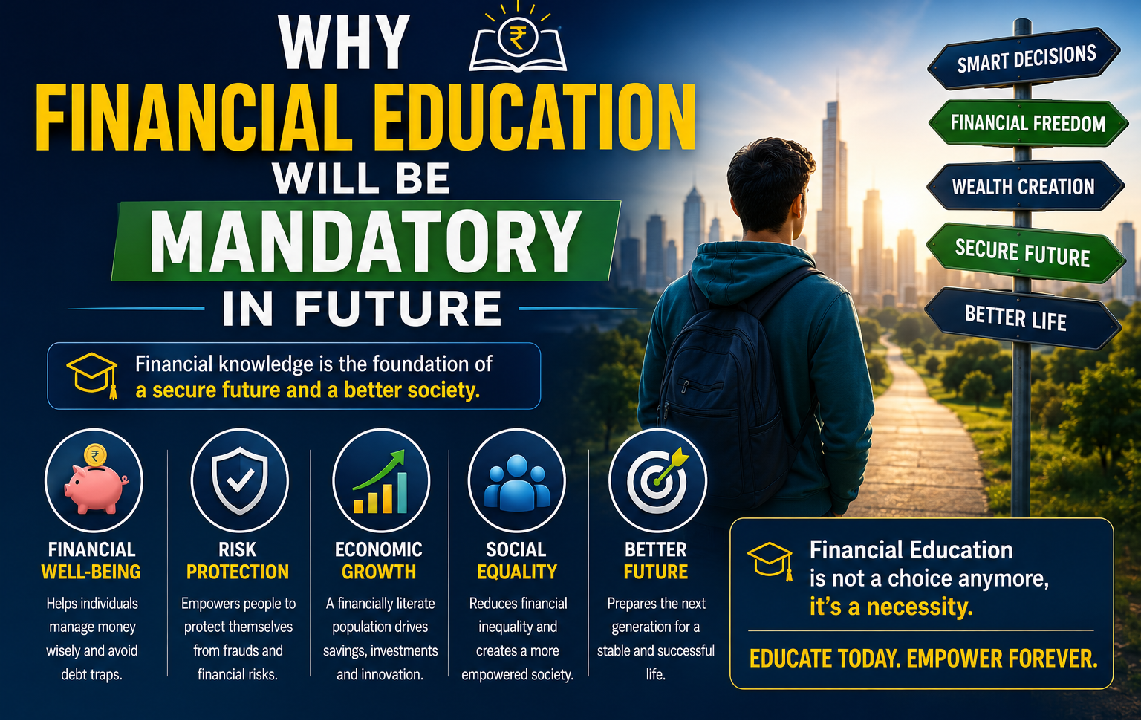
For decades, schools have focused on teaching subjects like mathematics, science, history, and language. While these subjects are important, one critical life skill has often been overlooked: financial education.
Many students graduate with good academic knowledge but little understanding of money management, investing, taxes, budgeting, or wealth creation. As the world becomes more complex and financially driven, financial education is expected to become a necessity rather than an option.
In the coming years, understanding money may become just as important as reading and writing.
The Problem with Traditional Education
Most schools prepare students for exams and careers, but not necessarily for managing their finances.
Students often learn:
✅ Algebra
✅ Chemistry
✅ Geography
✅ Literature
But rarely learn:
❌ How to create a budget
❌ How credit works
❌ How to invest money
❌ How taxes affect income
❌ How to build wealth
As a result, many adults enter the workforce without the financial skills needed to make informed decisions.
Why Financial Education Is Becoming Essential
1. Rising Cost of Living
Inflation, housing costs, healthcare expenses, and education fees continue to rise globally.
Without financial knowledge, people may struggle to:
- Manage expenses
- Save effectively
- Build emergency funds
- Plan for retirement
Financial education helps individuals adapt to economic challenges and make smarter money decisions.
2. Easy Access to Financial Products
Today, anyone with a smartphone can access:
- Stock markets
- Mutual funds
- ETFs
- Digital banking
- Cryptocurrency platforms
- Online lending services
While access has become easier, understanding these products remains crucial. Financial education helps people avoid costly mistakes and scams.
3. Growing Importance of Investing
Simply saving money is often not enough to build wealth.
Many successful individuals understand:
- Investing
- Compound growth
- Asset allocation
- Risk management
One of the most important concepts in financial education is compound growth
Learning how money grows over time can completely change a person’s financial future.
Schools vs Real Financial Knowledge
| Traditional School Education | Real Financial Education |
|---|---|
| Focuses on grades | Focuses on financial decisions |
| Teaches theory | Teaches practical money skills |
| Prepares for jobs | Prepares for wealth building |
| Measures academic success | Measures financial outcomes |
| Rarely covers investing | Encourages financial literacy |
The goal is not to replace traditional education but to complement it with practical financial skills.
Skills Future Generations Will Need
Budgeting
Understanding income, expenses, and savings goals.
Investing
Learning how stocks, mutual funds, and other assets create long-term wealth.
Risk Management
Protecting money through diversification and smart decision-making.
Tax Awareness
Understanding how taxes impact earnings and investments.
Digital Finance
Managing money in a world increasingly driven by technology and AI.
The Role of AI in Financial Education
Artificial Intelligence is making financial learning more accessible than ever.
AI tools can help people:
- Learn investment concepts
- Analyze financial data
- Track spending habits
- Create financial plans
- Understand market trends
Future financial education will likely combine traditional learning with AI-powered guidance.
Benefits of Financial Education
People with strong financial knowledge are often better equipped to:
✅ Manage debt responsibly
✅ Build savings consistently
✅ Invest with confidence
✅ Avoid financial scams
✅ Plan for long-term goals
✅ Achieve financial independence
Financial literacy does not guarantee wealth, but it significantly improves decision-making.
Why Financial Education May Become Mandatory
Governments, schools, and organizations increasingly recognize that financial literacy is a public necessity.
Future economies will require citizens who understand:
- Personal finance
- Investing
- Credit management
- Retirement planning
- Digital financial systems
As financial products become more complex, basic financial education may eventually become a standard part of school curricula worldwide.
Conclusion
The future belongs to those who understand both knowledge and money. Traditional education provides valuable academic foundations, but real financial education teaches people how to manage, grow, and protect their wealth.
As technology, investing, and digital finance continue to evolve, financial literacy will become one of the most important life skills. The question is no longer whether financial education is important—it is whether future generations can afford to live without it.