

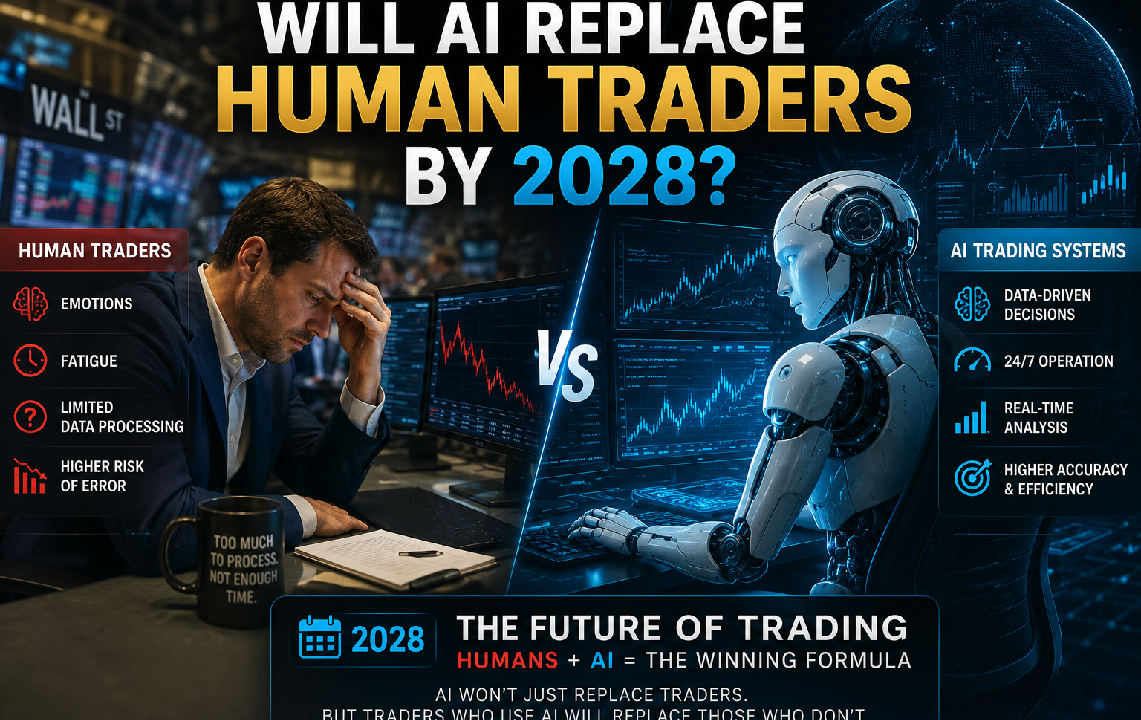
Artificial Intelligence (AI) has transformed the financial markets at an unprecedented pace. From algorithmic trading systems that execute thousands of transactions per second to predictive analytics that identify market trends before they become obvious, AI is becoming an essential tool for traders worldwide. As we approach 2028, a pressing question emerges: Will AI completely replace human traders, or will humans continue to play a vital role in financial markets?
The answer is more complex than a simple yes or no. While AI is rapidly changing how trading operates, human judgment, experience, and strategic thinking still hold significant value.
The Rise of AI in Trading
Over the past decade, AI-powered trading systems have gained widespread adoption among hedge funds, investment banks, and retail trading platforms. These systems can:
- Analyze massive amounts of market data in real time.
- Identify trading opportunities within milliseconds.
- Execute trades without emotional bias.
- Monitor multiple markets simultaneously.
- Adapt strategies based on changing market conditions.
Unlike human traders, AI does not experience fear, greed, stress, or fatigue. This gives it a significant advantage in fast-moving financial markets where speed and accuracy are crucial.
Why AI Is Becoming So Powerful
1. Data Processing at Scale
Modern financial markets generate enormous volumes of data every second. AI can process:
- Price movements
- News articles
- Economic reports
- Social media sentiment
- Company earnings data
By analyzing these datasets simultaneously, AI can uncover patterns that would be impossible for humans to detect manually.
2. Emotion-Free Decision Making
Many trading losses occur because of emotional decisions. Fear can cause traders to exit positions too early, while greed can encourage excessive risk-taking. AI follows predefined rules and data-driven models, eliminating emotional interference.
3. Continuous Learning
Machine learning algorithms can improve over time by studying historical market behavior and adapting to new information. This enables AI systems to refine their strategies and increase efficiency.
Areas Where Human Traders Still Excel
Despite AI’s impressive capabilities, human traders possess qualities that technology cannot fully replicate.
Strategic Thinking
Markets are influenced by geopolitical events, regulatory changes, and unexpected crises. Human traders can interpret broader contexts and make decisions based on intuition and experience.
Creativity and Innovation
AI works within the framework of its training data and algorithms. Humans, however, can develop entirely new trading approaches and adapt to situations that have never occurred before.
Understanding Market Psychology
Financial markets are driven not only by numbers but also by human behavior. Understanding investor sentiment, crowd psychology, and behavioral finance remains a critical skill where humans maintain an advantage.
Ethical and Regulatory Oversight
As AI becomes more influential in financial markets, human oversight is necessary to ensure compliance, fairness, and risk management.
Will AI Replace Retail Traders?
For retail traders, AI tools are becoming increasingly accessible. Automated trading bots, AI-powered analytics platforms, and predictive market tools are already available to individual investors.
However, rather than replacing retail traders, AI is more likely to become a powerful assistant. Traders who learn how to leverage AI effectively may gain a competitive edge over those who rely solely on traditional methods.
The future belongs not necessarily to AI alone, but to traders who know how to combine human insight with AI-driven intelligence.
The Hybrid Trading Model: The Most Likely Future
Industry experts increasingly believe that the future of trading will be a collaboration between humans and AI.
In this hybrid model:
- AI handles data analysis and execution.
- Humans provide strategic direction.
- AI identifies opportunities.
- Humans evaluate broader market implications.
- AI manages routine tasks.
- Humans focus on risk management and innovation.
This partnership allows traders to benefit from the strengths of both technology and human expertise.
What Could Trading Look Like in 2028?
By 2028, we can expect:
Increased Automation
More trades will be executed automatically using AI-powered systems.
Advanced Predictive Analytics
AI models will become more accurate at forecasting short-term market movements.
Personalized Trading Assistants
Retail investors may have access to AI assistants that provide real-time recommendations tailored to their investment goals.
Enhanced Risk Management
AI will help identify potential risks faster and more accurately than traditional methods.
Greater Human-AI Collaboration
Successful traders will likely be those who integrate AI into their workflows rather than compete against it.
Challenges AI Still Faces
Despite rapid progress, AI is not without limitations:
- Difficulty predicting unprecedented events.
- Dependence on historical data.
- Potential algorithmic biases.
- Regulatory concerns.
- Cybersecurity risks.
Unexpected events such as economic crises, political conflicts, or global pandemics can create market conditions that AI models may struggle to interpret effectively.
Conclusion
Will AI replace human traders by 2028? Probably not completely.
AI will undoubtedly continue to automate many aspects of trading and outperform humans in data processing, speed, and efficiency. However, human traders bring strategic thinking, creativity, judgment, and market intuition that remain difficult to replicate.